
Cambodia temples extend far beyond Angkor Wat, which draws the crowds for good reason but is only the most famous monument in a much wider landscape. This guide covers what makes each one worth the trip, along with the timing, access, and private touring details needed to plan a visit properly.
Why Other Cambodian Temples Are Worth It
Cambodia’s temples span four centuries of Khmer rule and vary enormously in style, condition, and distance from Siem Reap, and that variety is the reason to look past Angkor Wat rather than settle for it alone. Some sites sit inside the standard Angkor Archaeological Park and pair naturally with a day already built around the main temples.
Others require a separate fee, a longer drive, or a dedicated day of their own. Knowing which is which before setting out makes the difference between a rushed add-on and a properly planned second or third day of temple visits.

About Do Not Disturb
Do Not Disturb is a luxury travel company specializing in carefully designed journeys and considered experiences. Each itinerary we build for our clients is informed by real destination knowledge, offering insight into places, cultures, and moments that shape how a trip comes together.
If this destination has sparked ideas, the itinerary can be developed into a private journey tailored to your interests and travel style, with hand-picked stays, thoughtful routing, and experiences curated around what matters most to you.
Banteay Srei
Banteay Srei sits about 25 kilometers northeast of the main Angkor temple group, built in the 10th century and consecrated in 967 CE. Unlike most Angkorian monuments, it wasn’t commissioned by a king but by courtiers serving under Rajendravarman II, which may explain its unusual character.
The temple is built almost entirely from red sandstone, a material soft enough to carve with the precision of woodwork, and its walls, pediments, and lintels carry some of the finest decorative carving found anywhere at Angkor.
The buildings themselves are small in scale, and that combination of miniature architecture and dense ornamentation has earned Banteay Srei its modern name, usually translated as Citadel of Women, likely a reference to the intricacy of the carving and the many devata figures worked into the walls. Banteay Srei is covered by the standard Angkor Pass, so it fits easily into a day that also covers the main Angkor Wat and Angkor Thom sites, though the distance means it works best as a dedicated half-day trip on its own.

Beng Mealea
Beng Mealea lies about 77 kilometers from Siem Reap by road, built in the early 12th century under Suryavarman II, the same king responsible for Angkor Wat itself, and in an identical architectural style.
What sets Beng Mealea apart is its condition. Where the main Angkor sites have been cleared and partially restored, Beng Mealea has been left largely as it was found, with trees growing directly through collapsed towers and stone lying in the piles where it fell centuries ago. Carvings depicting Hindu mythology survive among the ruins, including a scene of the Churning of the Sea of Milk, and causeways lined with seven-headed naga serpent balustrades still frame the approach.
Beng Mealea requires a separate admission fee outside the standard Angkor Pass, and a newer road built toward Koh Ker now passes directly by the site, making the two a natural pairing for travellers heading further out from Siem Reap.

Bayon
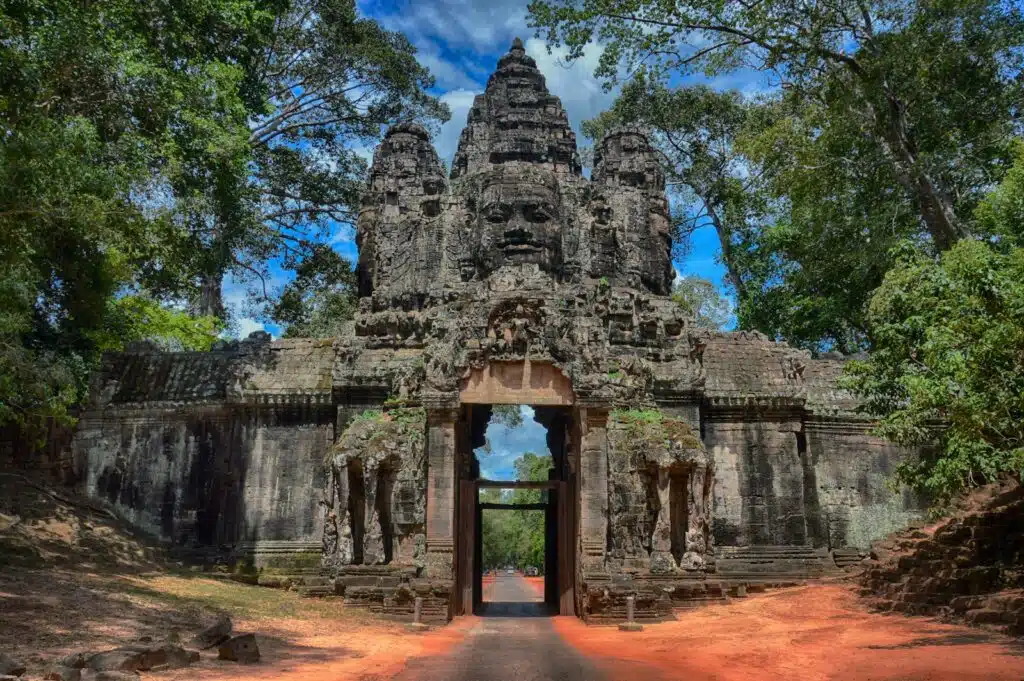
Bayon sits at the exact centre of Angkor Thom, built in the late 12th or early 13th century as the state temple of King Jayavarman VII.
It’s best known for its face towers, roughly 200 giant, calm stone faces spread across what remains of the temple’s original 49 towers, widely interpreted as a blend of the king’s own likeness with Avalokiteshvara, the bodhisattva of compassion.
Bayon’s outer gallery carries some of the most detailed bas-reliefs at Angkor, showing military processions, a naval battle between Khmer and Cham forces, and scenes of everyday life including markets, cockfights, and wrestling matches, making it one of the richest visual records of Angkorian society left standing. Because roads lead to Bayon directly from each of Angkor Thom’s four gates, it’s easily folded into a standard day at the main Angkor Wat temples rather than requiring a separate trip, and it’s covered by the standard Angkor Pass.

Koh Ker
Koh Ker sits about 120 kilometers from Siem Reap, roughly two and a half hours by road, making it the most remote of the four. The site briefly served as the capital of the entire Khmer Empire from 928 to 944 CE, under Jayavarman IV and his successor Harshavarman II, before the seat of power moved back toward Angkor.
Its standout structure is Prasat Thom, a linear temple complex anchored by a 36-meter, seven-tiered sandstone pyramid known as the Prang, believed to have served as Jayavarman IV’s state temple. A newer staircase now allows visitors to climb it, since the original stone stairs and a later bamboo ladder are both too damaged for safe use. More than 180 sanctuaries have been identified across the surrounding protected area, though only about two dozen are currently open to visitors.
Koh Ker was named a UNESCO World Heritage Site in 2023 and sits outside the main Angkor Archaeological Park, so it requires its own access arrangement separate from the standard Angkor Pass.

Planning a Visit and Booking Private Touring
The standard Angkor Pass, issued by the state-run Angkor Enterprise, comes in three tiers, a one-day pass, a three-day pass valid over a flexible 10-day window, and a seven-day pass valid over 30 days. It covers Bayon and Banteay Srei along with the rest of the core Angkor Archaeological Park, but Beng Mealea and Koh Ker both require separate admission arranged in addition to the main pass. One detail worth building into a schedule, passholders can enter the park from 5pm the evening before their pass officially activates, a useful window for a sunset visit that doesn’t use up a full day of the pass.
Given the range in distance, from Banteay Srei’s short trip out from the main temples to Koh Ker’s two and a half hour drive, a private guide and driver make the difference between a rushed itinerary and a properly paced one. A typical approach pairs Banteay Srei with a day already covering Angkor Wat and Bayon, then dedicates a separate full day to Beng Mealea and Koh Ker together, since the road connecting them makes visiting both in one trip straightforward. Dress codes covering shoulders and knees apply at every checkpoint, and it’s worth keeping the physical pass on hand throughout the day, since losing it means paying a fine and buying a new one.
Plan your own version of this journey
Speak to Do Not Disturb’s luxury travel experts and turn this moment into something personal.
Related destinations
Suggested articles

Best Winter Sun Honeymoon Destinations in Europe
Portugal vs Spain for Your Honeymoon – Which Should You Choose?
One Island or Two? Splitting Your Maldives Honeymoon Between Resorts

Best Honeymoon Destinations for Autumn

Italy vs Greece for Your Honeymoon – Which is Better?
48 Hours in Lima: Where to Eat, Stay and Explore

A Cultural Honeymoon in Peru: Machu Picchu, Cusco, the Sacred Valley and the Amazon

Peru or Mexico: Which Ancient Civilisation Should You Visit First?
The Best Time to Visit Machu Picchu for Fewer Crowds

Why So Many Travellers Fall for Kanazawa
Kyoto or Kanazawa – Which Is Better for Traditional Japan?
What Is a Kissaten? Inside Japan’s Historic Coffee Shop Culture
Kruger or a Private Reserve? Where to Safari in Greater Kruger