

Southwest of Angkor and the temples that draw most first-time visitors to Cambodia, the Cardamom Mountains hold one of the last large, unbroken rainforests left in Southeast Asia. This is an introduction to that rainforest interior, the rivers that run through it, the wildlife it shelters, the lodges built to reach it responsibly, and how a stay here fits into a longer Cambodia itinerary.
Why the Cardamom Mountains Reward a Different Kind of Trip
The Cardamom Mountains in Cambodia offer something the rest of the country’s well-worn circuit doesn’t, genuine remoteness. Roads are limited, mobile signal drops out for stretches, and most travel through the interior happens by boat or on foot. That isolation is also what has kept the forest largely intact, protecting it from the roads, plantations, and development that have fragmented rainforest elsewhere in the region.
A stay here works best as a deliberate contrast to the rest of a Cambodia trip. Where Angkor is about scale and history and the coast is about ease, the Cardamoms are about slowing down inside a working ecosystem, one where the lodges themselves are often part of the conservation effort rather than separate from it.

About Do Not Disturb
Do Not Disturb is a luxury travel company specializing in carefully designed journeys and considered experiences. Each itinerary we build for our clients is informed by real destination knowledge, offering insight into places, cultures, and moments that shape how a trip comes together.
If this destination has sparked ideas, the itinerary can be developed into a private journey tailored to your interests and travel style, with hand-picked stays, thoughtful routing, and experiences curated around what matters most to you.
River Travel
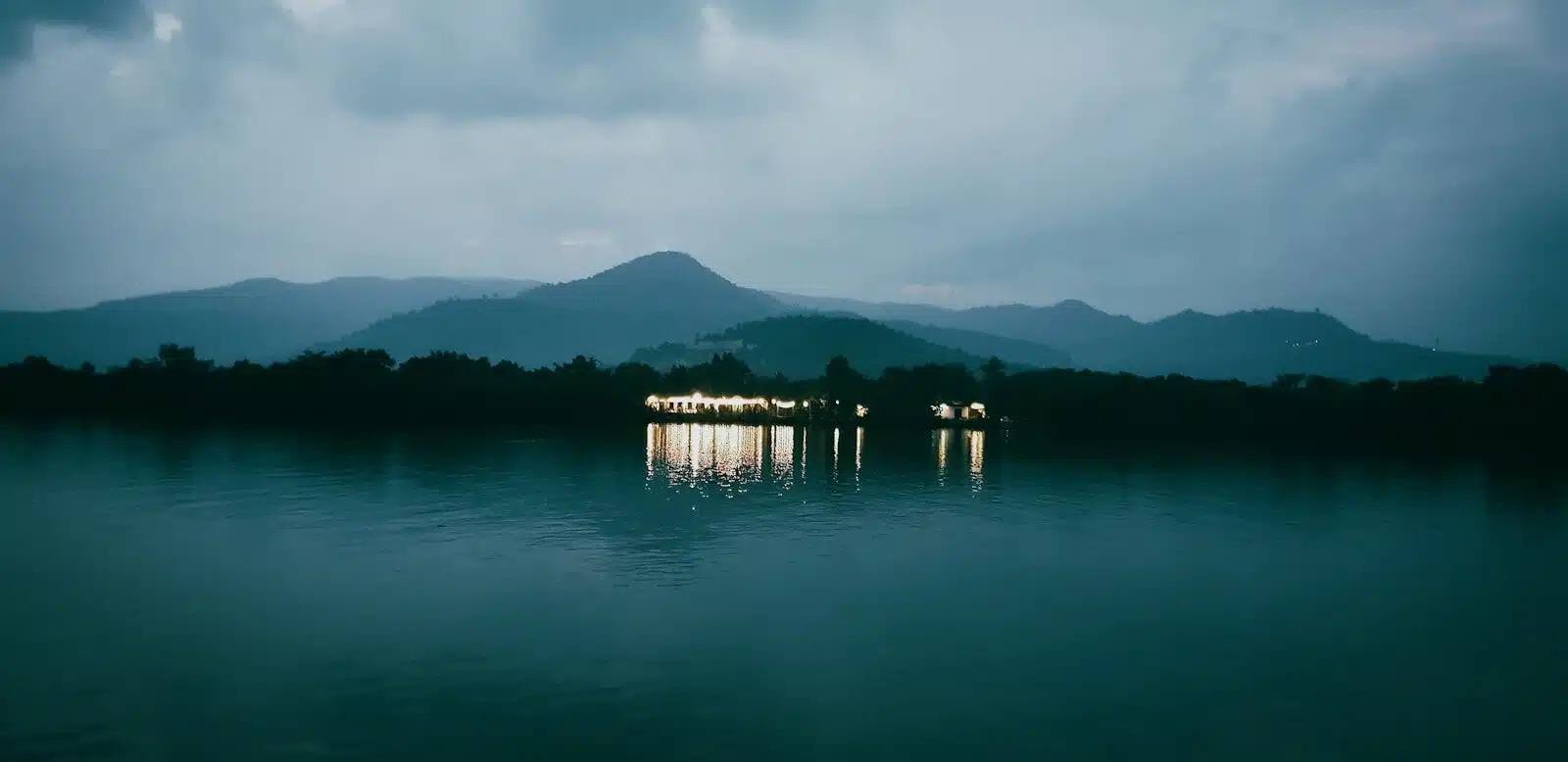
Cambodia’s Cardamom rivers are the main way most visitors move through the forest, and each one opens onto a different stretch of the landscape. The Preak Tachan River runs past Cardamom Tented Camp in Botum Sakor National Park, where kayaking trips and night boat safaris cover water otherwise inaccessible on foot. Further into the interior, the Preak Piphot River provides boat access to Veal Thmar Waterfall, and the Tmor Rung River threads through some of the densest jungle in the range.
On the western edge of the Cardamoms, near the Thai border, the riverside town of Tatai sits close to the South Cardamom protected area. The Tatai Waterfall here flows gently year-round rather than crashing with force, forming pools shallow enough to swim in after a walk or a boat ride from the nearby 4 Rivers Floating Ecolodge.

Wildlife
The Cardamom rainforest supports more than 60 globally threatened animal species, among the highest concentrations of endangered wildlife left in mainland Southeast Asia. Asian elephants move through one of the region’s last unfragmented elephant corridors, and Wildlife Alliance’s ranger patrols have recorded zero elephant poaching in the area since 2006. Clouded leopards, Sunda pangolins, sun bears, dholes, and pileated and yellow-cheeked crested gibbons all live within the forest, alongside rarer sightings of the marbled cat.
The rivers themselves hold two of the region’s most significant conservation stories. The Siamese crocodile was believed extinct in the wild until a population was rediscovered in the Cardamoms in 2000, and the species now numbers roughly 400 individuals here, making the area its core global stronghold. The Irrawaddy dolphin swims in the same river network, with fewer than 100 remaining anywhere in the world.

Remote Lodges
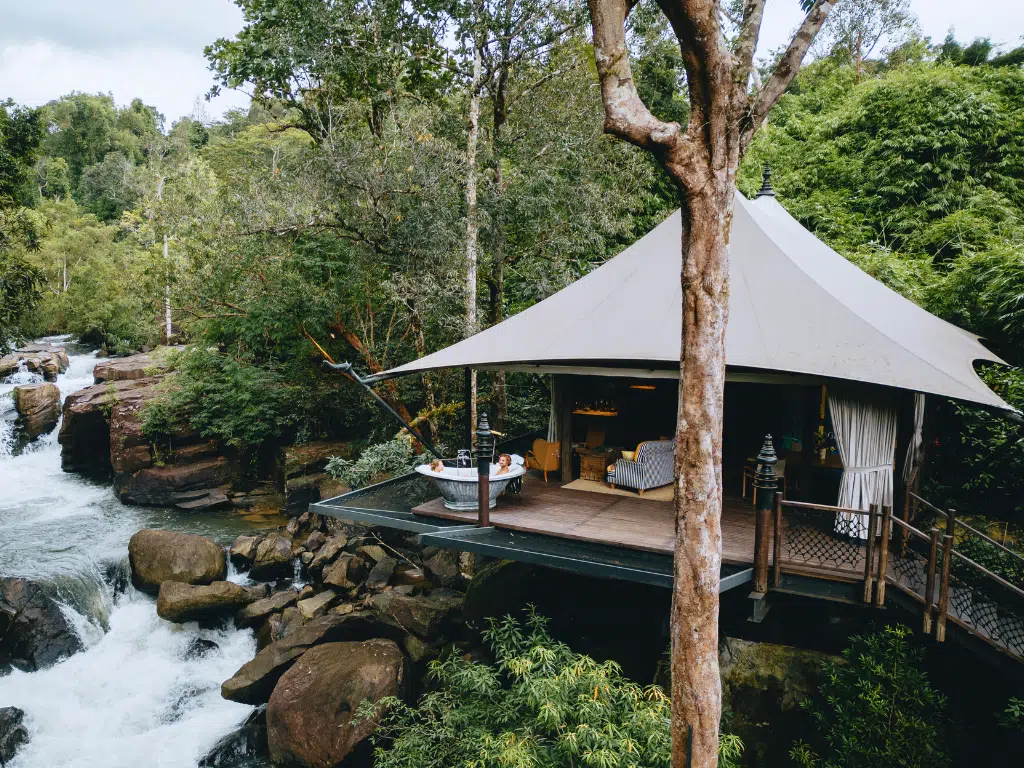
A small number of lodges give access to the Cardamom interior while funding the conservation work that protects it. Cardamom Tented Camp sits inside Botum Sakor National Park, Cambodia’s largest protected area, with safari-style tents, a Riverbank Restaurant, and solar-powered operations, and guests can join camera trap research or ranger patrol support alongside jungle treks and river kayaking.
Shinta Mani Wild takes a different approach entirely. Guests arrive by a 400-meter zipline over the treetops before settling into one of 15 tents designed by architect Bill Bensley along a private stretch of river. Stays run a minimum of three nights and include jungle cruises by custom pontoon, spa treatments beside a waterfall, foraged multi-course dinners, and the option to join the property’s own anti-poaching patrols. On the western side of the range, the 4 Rivers Floating Ecolodge near Tatai offers a simpler base within walking distance of Tatai Waterfall, suited to kayaking and forest walks rather than the more elaborate programmeming further east.
Conservation Projects
Behind almost every lodge and river route in the Cardamoms sits Wildlife Alliance, the organization responsible for direct protection across 1.7 million hectares of the Cardamom Rainforest Landscape. Since 2002, its rangers have rescued around 7,000 wild animals, removed more than 275,000 snares, and run over 7,000 patrols a year across 16 ranger stations, covering roughly 270,000 kilometers of forest, river, and coastline annually.
Cardamom National Park itself, gazetted in 2016 with support from Wildlife Alliance and now a focus of Global Conservation’s own protection efforts, spans over 820,000 hectares of monsoon forest, mangroves, and wetlands. Visiting the Cardamoms through one of the lodges above puts tourism revenue directly behind this work, a rare case where a stay in the forest funds the patrols keeping it standing.

Fitting the Cardamoms into a Longer Cambodia Itinerary
Most visitors reach the Cardamom interior from Phnom Penh, typically to the village of Chi Phat, a journey of around four hours by bus and boat. From there, a stay of two to three nights is usually enough to cover a trek, a river kayaking trip, and time around camp before moving on. Longer Cambodia itineraries commonly position the Cardamoms between Phnom Penh and the coast, using the forest as a deliberate change of pace before continuing to the beaches around Koh Rong or Sihanoukville, or looping back toward Siem Reap and the temples of Angkor.
The contrast is the point. Three days spent trekking, kayaking, and staying inside a working conservation project sit well against the history of Phnom Penh on one side and the ruins of Angkor or the coastline on the other, giving a Cambodia trip a rainforest interior that most itineraries skip entirely.
Plan your own version of this journey
Speak to Do Not Disturb’s luxury travel experts and turn this moment into something personal.
Related destinations
Suggested articles
Portugal vs Spain for Your Honeymoon – Which Should You Choose?
One Island or Two? Splitting Your Maldives Honeymoon Between Resorts

Best Honeymoon Destinations for Autumn

Italy vs Greece for Your Honeymoon – Which is Better?
48 Hours in Lima: Where to Eat, Stay and Explore

A Cultural Honeymoon in Peru: Machu Picchu, Cusco, the Sacred Valley and the Amazon

Peru or Mexico: Which Ancient Civilisation Should You Visit First?
The Best Time to Visit Machu Picchu for Fewer Crowds

Why So Many Travellers Fall for Kanazawa
Kyoto or Kanazawa – Which Is Better for Traditional Japan?
What Is a Kissaten? Inside Japan’s Historic Coffee Shop Culture
Kruger or a Private Reserve? Where to Safari in Greater Kruger
The Best Time to Visit Kruger for Wildlife, Weather and Fewer Crowds