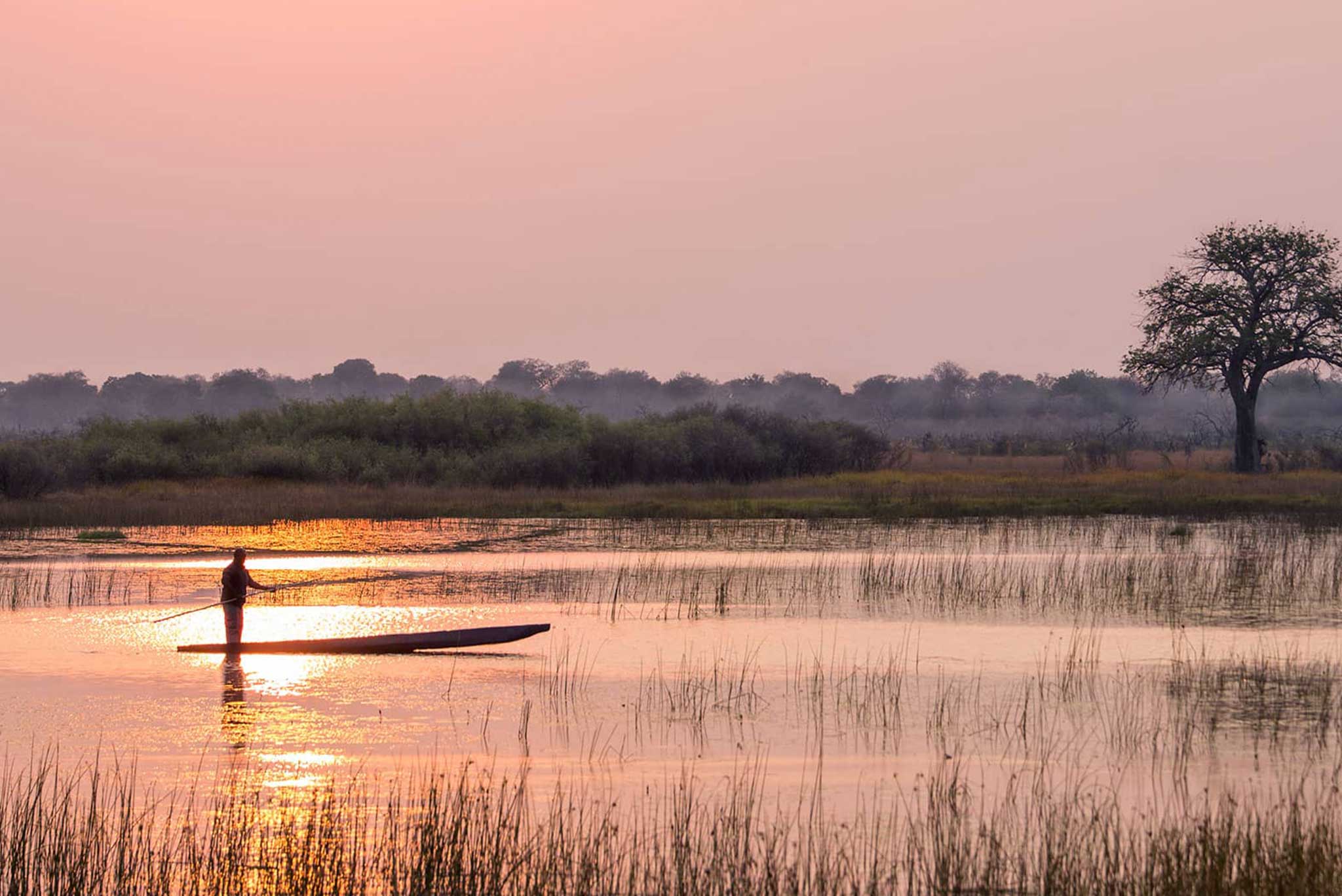


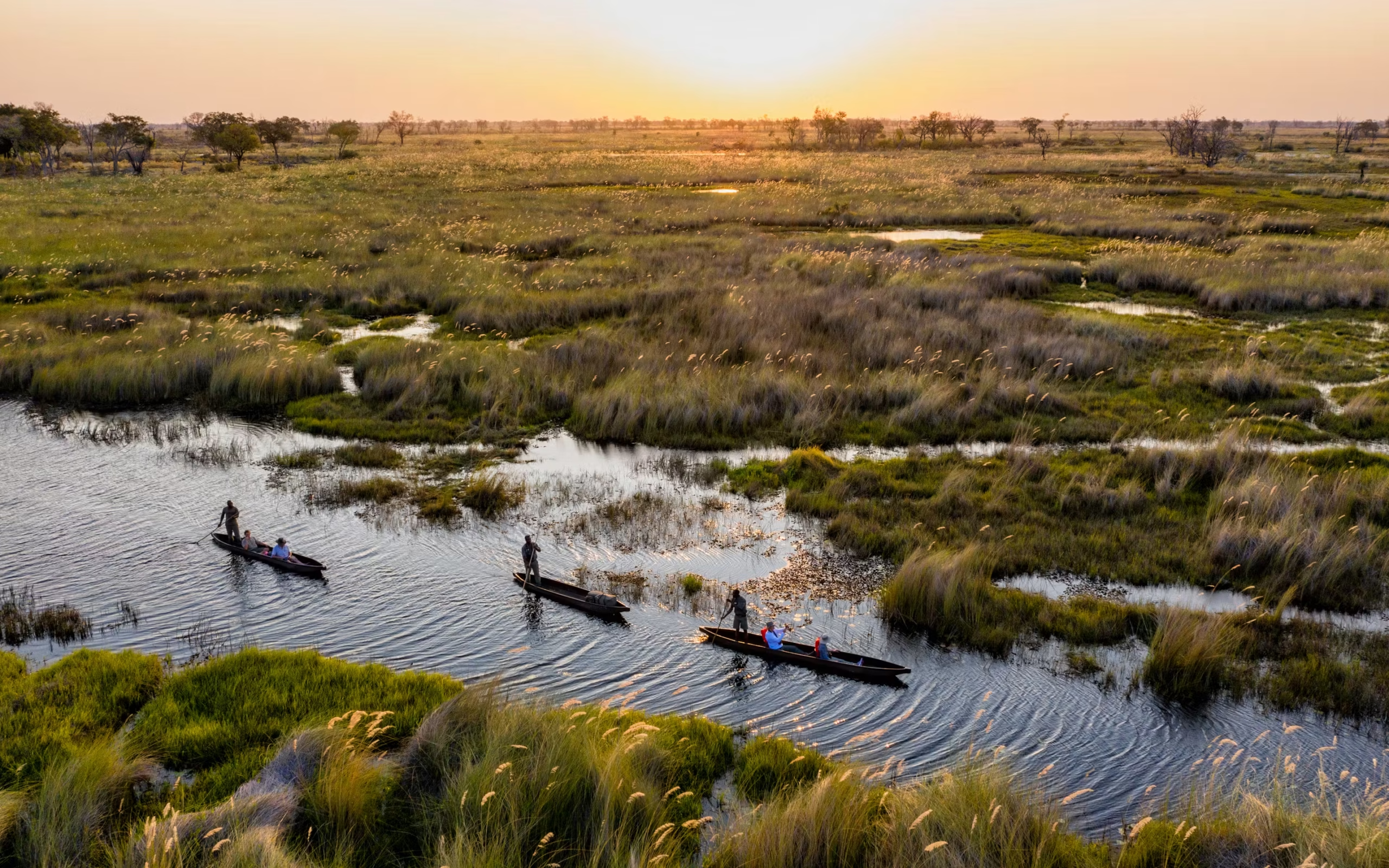
A dawn journey by mokoro through the Okavango Delta, guided by a local poler navigating channels that have been travelled by dugout canoe for generations. One of the few ways to move through a UNESCO World Heritage Site at water level, in near silence, at a pace the wilderness sets.
The Okavango Delta sits in northwestern Botswana and covers around 15,000 square kilometers during peak flood season, when water from the Angolan highlands travels south through the Kavango River and spreads across the Kalahari basin.
It is one of the few river systems in the world that does not reach the sea. The water arrives, spreads, and eventually evaporates, creating a wetland ecosystem that supports elephant, hippo, crocodile, leopard, lion, wild dog, and around 550 species of bird.
A mokoro is a dugout canoe, traditionally carved from a single trunk of ebony or sycamore fig, though fiberglass versions are now more common as part of conservation efforts to protect the trees.
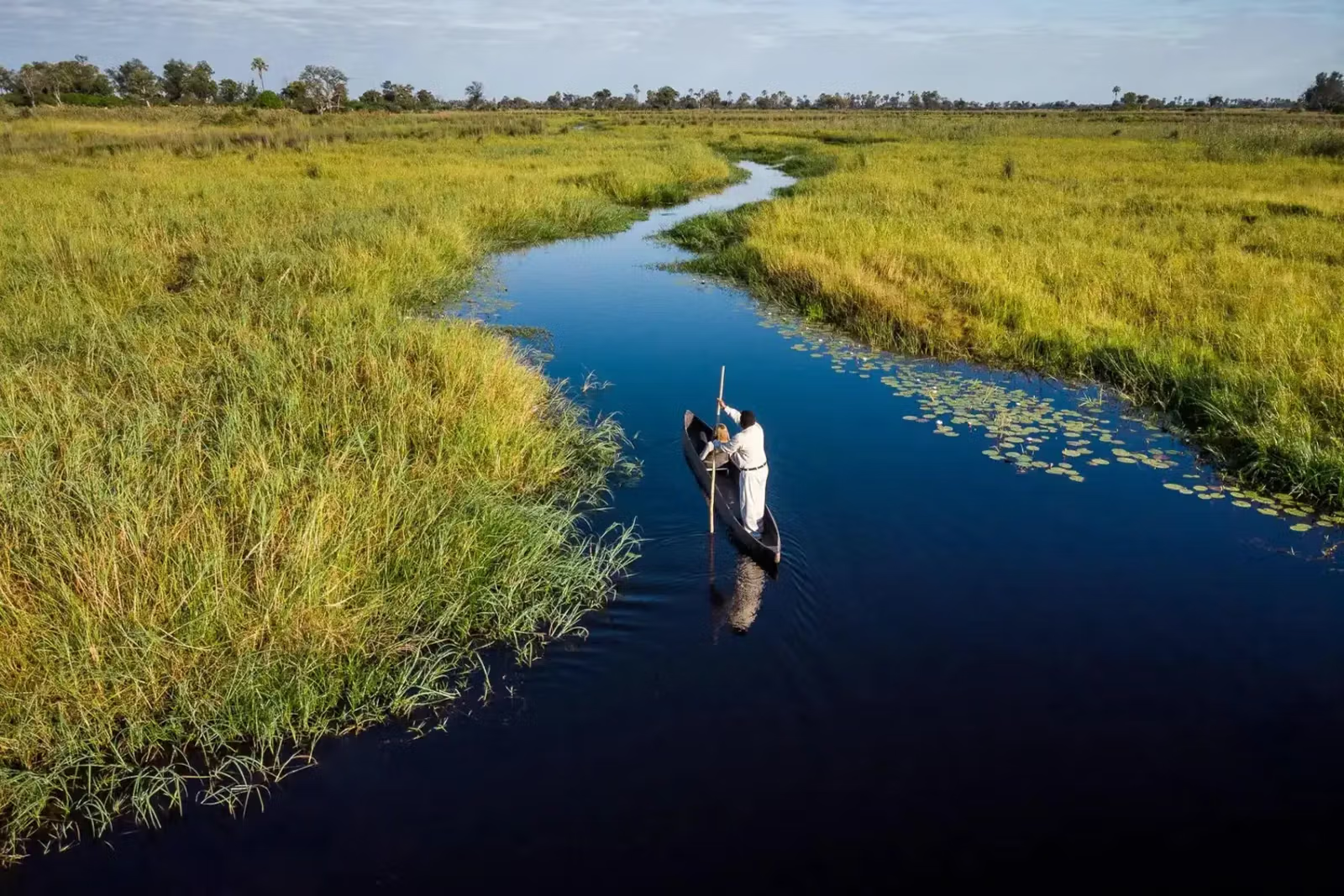
The poler stands at the stern and moves the boat with a pole pushed against the riverbed, steering through channels that vary in width from a few meters to stretches wide enough to feel like open water. It is a method of travel that has been in use in the Delta for centuries, and one that the communities surrounding the wetland have refined across generations.
About Do Not Disturb
Do Not Disturb is a luxury travel company specializing in carefully designed journeys and considered experiences. Each itinerary we build for our clients is informed by real destination knowledge, offering insight into places, cultures, and moments that shape how a trip comes together.
If this destination has sparked ideas, the itinerary can be developed into a private journey tailored to your interests and travel style, with hand-picked stays, thoughtful routing, and experiences curated around what matters most to you.
Cultural and Historical Context
The communities of the Okavango have relied on the mokoro as a means of transport, fishing, and movement through the Delta for as long as the wetland has existed in its current form.
The knowledge held by an experienced poler covers water depth, channel navigation, seasonal flooding patterns, animal behavior, and the identification of birds, plants, and tracks. It is a form of expertise that takes years to develop and one that no briefing document or vehicle tour can replicate.
The Okavango Delta became a UNESCO World Heritage Site in 2014, recognized for its position as one of the largest and most intact inland delta systems on Earth. The designation acknowledged not only the ecological significance of the wetland but also the role of the communities living within and around it in maintaining that integrity.
A mokoro journey with a local poler is, in that context, not simply a wildlife activity. It is a direct engagement with a knowledge system that has shaped this landscape for generations.

Why Private or Small-Group Access Matters
A mokoro journey works best with one canoe, two people, and a poler whose attention is entirely on the experience in front of them. The Delta is a place where what you notice depends entirely on how quiet you are and how much time you spend in any given stretch of water.
A private arrangement means the poler can pause without disrupting a convoy, take a longer route to follow a bird, or sit in silence in a channel where a hippo has surfaced fifty meters ahead.
It means the pace of the journey is set by what is happening on the water, not by a schedule built around a larger group. The difference between a private mokoro and a shared one is the difference between moving through the Delta and actually being in it.
What You See
The Delta at dawn is a different environment to the one that exists by mid-morning. The light comes in low and flat across the water, turning the surface of the channels the colour of copper before shifting to silver as the sun rises. Mist sits in the papyrus beds.
The birdlife is at its most active in the hours after sunrise, and the sounds of a mokoro journey at that time, the calls of fish eagles, the movement of reed frogs, the occasional exhale of a hippo in the channel ahead, carry across the water in a way that disappears once the day warms up.
The papyrus reeds that line the Delta’s channels grow to three or four meters in height, making the open lagoons feel significant when the channel widens into them. African jacanas walk across lily pads. Malachite kingfishers drop from the reeds without warning. Elephants cross channels at points the poler already knows to look for, leaving tracks that cut through the mud at the waterline.
The deeper channels carry hippo, and a poler will read the water ahead for signs of their presence before entering a narrow stretch. Crocodiles sun themselves on sandbanks in the morning light. The rhythm of the journey is built around observation, pausing, and moving forward when the moment is right.

How Do Not Disturb Makes This Possible
Do Not Disturb works with a small number of camps and guides in the Delta whose standards are consistent with what a private mokoro experience requires.
Logistics across Botswana involve internal flights between bush strips, timing around the flood cycle, and an understanding of which areas of the Delta are most productive at a given point in the season. The team handles all of that before you arrive, so that the morning of the journey involves nothing more than stepping into the canoe.
Ready to plan your mokoro journey through the Okavango Delta and experience Botswana at water level? Speak with Do Not Disturb to begin your journey.
Plan your own version of this journey
Speak to Do Not Disturb’s luxury travel experts and turn this moment into something personal.
Related destinations
Suggested articles
Where to Go On Honeymoon? A Guide to Help You Choose
Wilderness to Waves: Luxury Honeymoons in Kenya
Why Botswana Is Africa’s Most Exclusive Safari Destination
Tanzania vs. Botswana: Which African Safari Should You Choose?

The Okavango Delta: Africa’s Most Unique Safari Destination

Okavango Delta vs. Kruger National Park: Which Safari Is Right for You?

Best Winter Sun Honeymoon Destinations in Europe
Portugal vs Spain for Your Honeymoon – Which Should You Choose?
One Island or Two? Splitting Your Maldives Honeymoon Between Resorts

Italy vs Greece for Your Honeymoon – Which is Better?
48 Hours in Lima: Where to Eat, Stay and Explore

A Cultural Honeymoon in Peru: Machu Picchu, Cusco, the Sacred Valley and the Amazon

Peru or Mexico: Which Ancient Civilisation Should You Visit First?