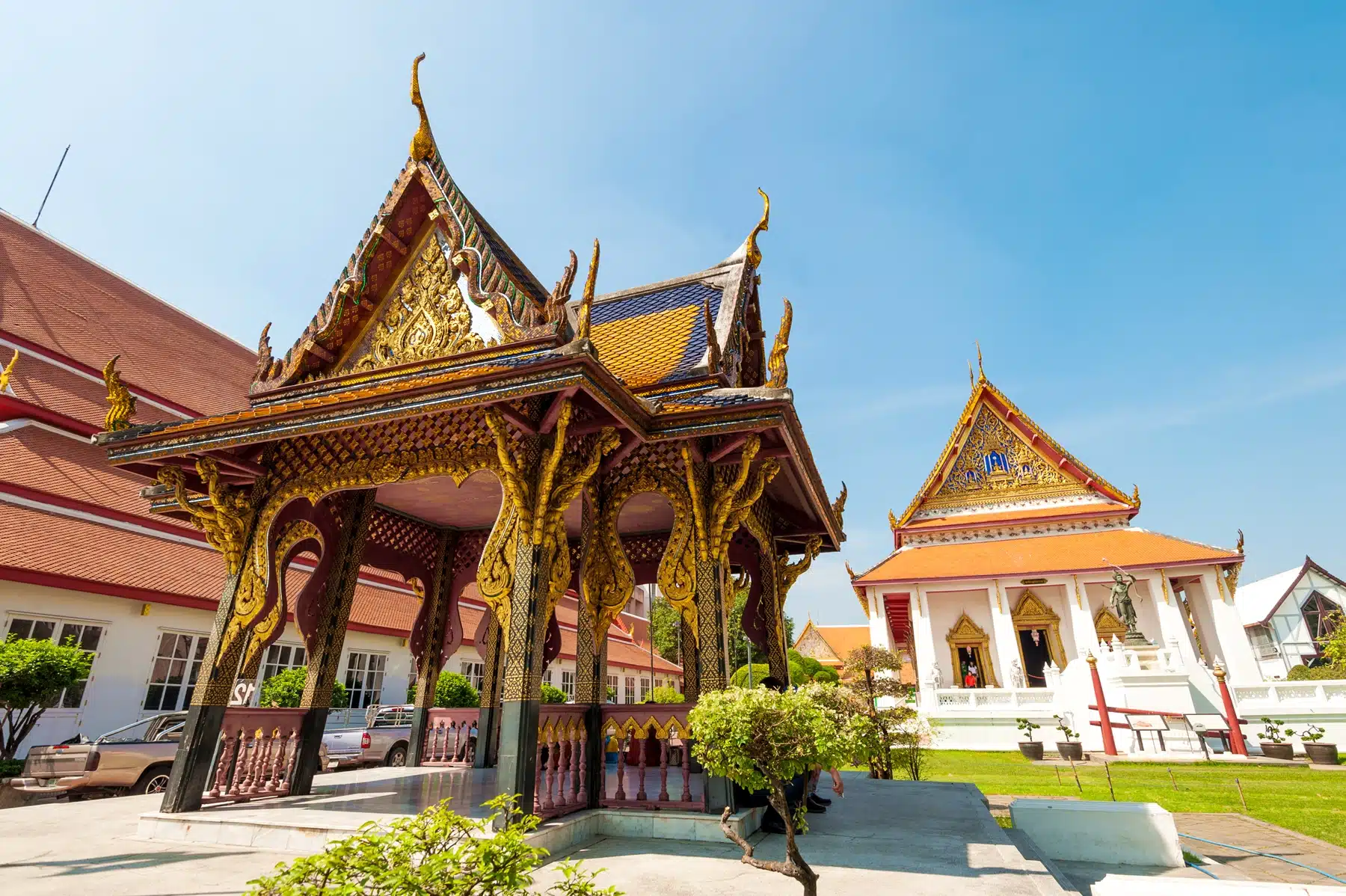


A private guided visit to Bangkok National Museum offers a clear, human introduction to Thailand’s history, where art, ritual, and daily life are explained through objects that still shape the country today.
Entering the Museum Grounds
Bangkok National Museum sits just north of the Grand Palace, but the atmosphere changes almost immediately once you step through its gates. The traffic noise quietens. The scale seems even grander. What replaces the intensity of central Bangkok is a sense of calm and excitement.
The museum occupies the former Wang Na Palace, once the residence of the viceroy during the early Rattanakosin period. The buildings were not originally designed as galleries but as living spaces for royalty, courtyards arranged around ceremony, power, and hierarchy. Walking in, you can sense that original purpose before you encounter a single object.

About Do Not Disturb
Do Not Disturb is a luxury travel company specializing in carefully designed journeys and considered experiences. Each itinerary we build for our clients is informed by real destination knowledge, offering insight into places, cultures, and moments that shape how a trip comes together.
If this destination has sparked ideas, the itinerary can be developed into a private journey tailored to your interests and travel style, with hand-picked stays, thoughtful routing, and experiences curated around what matters most to you.
Why This Museum Matters
Bangkok National Museum is Thailand’s largest and most comprehensive cultural institution. Its collection spans prehistoric tools, Hindu and Buddhist sculpture, royal regalia, ceremonial chariots, textiles, and everyday objects that reflect how people lived across centuries.
For most visitors, the scale is overwhelming. Without context, galleries blur together, and the significance of what you are seeing can be difficult to grasp.
What makes the museum important is not just the breadth of the collection but what it reveals about Thailand’s continuity. Unlike many countries in the region, Thailand was never colonized. Its monarchy, religious practices, and cultural systems evolved without interruption.

The Setting of Power
Former throne halls now house royal artifacts. Ceremonial buildings display items once used in coronations and funerals. These are not abstract displays but objects tied directly to ritual and authority.
Your guide explains how the viceroy’s palace functioned alongside the Grand Palace, balancing power within the early Bangkok court. Understanding this political structure adds depth to everything that follows.

Thailand's Buddhist Culture
One of the museum’s central collections focuses on Buddhist sculpture, and this is where a private experience becomes essential.
At first glance, rows of Buddha images appear similar. Bronze, stone, and gilded figures sit or stand in familiar poses. Without explanation, the details can be easy to miss.
A guide breaks this down clearly. You learn how posture, hand position, facial expression, and material indicate period, region, and philosophical emphasis. Sukhothai figures emphasize grace and spiritual idealism. Ayutthaya Buddhas feel heavier, more monumental, reflecting a different relationship between power and faith.
These are not purely artistic choices. They reflect how people understood the role of Buddhism in daily life and governance. The guide ties this to modern Thailand, where religious imagery still occupies public and private space with ease.

Everyday Life Preserved
Beyond royal and religious objects, the museum excels in showing how ordinary people lived.
Traditional musical instruments sit beside farming tools. Textiles reveal regional identities through color and pattern. Ceramics show trade connections with China, Persia, and Europe.
One gallery focuses on shadow puppetry and classical performance. Masks, costumes, and stage elements illustrate how stories from the Ramakien, Thailand’s national epic, were transmitted through movement and music rather than text.
For visitors unfamiliar with Thai culture, these displays explain why performance and ritual remain central today. Festivals, ceremonies, and even televised events still draw on these traditions.

Royal Ceremonies and Continuity
The Funeral Chariot Hall is one of the museum’s most striking spaces.Here, towering gilded chariots used in royal cremation ceremonies dominate the room. Their scale is difficult to process at first. They are ornate, symbolic, and deeply tied to cosmology rather than spectacle.
A private guide explains how these chariots represent Mount Meru, the center of the universe in Buddhist and Hindu belief. Royal funerals are not just farewells but cosmic events, returning the monarch to a divine realm.
Understanding this transforms how you see the Thai monarchy today. The reverence is not abstract loyalty but part of a worldview that links ruler, religion, and universe into a single system.

Why Private Access Changes the Experience
Bangkok National Museum is rarely crowded in the way temples or palaces are, but it is often underexplained. With a private guide, the visit becomes selective rather than exhaustive. You focus on key galleries that support understanding rather than attempting to see everything. This can help prevent fatigue and keeps your attention feeling sharp.
Questions are encouraged. Connections are drawn between past and present. The pace adjusts naturally, allowing time to sit, look, and absorb. Without this guidance, the museum can feel academic or distant. With it, the objects regain their human feel.

The Contrast with Bangkok Outside
Leaving the galleries briefly to cross courtyards, the contrast with the city outside becomes apparent. Bangkok’s speed, noise, and density feel distant. Inside the museum grounds, time stretches. The transition between spaces mirrors the broader experience of Thailand itself, where modern life exists alongside deep tradition without visible conflict.
This contrast helps contextualize the city beyond the museum walls. What can seem chaotic on the street becomes understandable when seen through historical patterns.

Moving Through the Galleries
As the tour progresses, the structure of the museum begins to make sense. Early history gives way to the rise of Siamese kingdoms. Trade routes appear through imported materials. Religious shifts become visible through iconography. Royal customs evolve while maintaining core symbolism.
Your guide points out small details that anchor understanding: the wear on a tool, the repair on a sculpture, and the reuse of materials across centuries. These details bring the collection closer to lived experience.

How Do Not Disturb makes it possible
Do Not Disturb arranges private tours of the Bangkok National Museum with specialist guides who focus on clarity rather than volume.
Tours are designed to fit within a broader cultural itinerary, often paired with nearby temples or royal sites. Timing is considered carefully, avoiding peak heat and allowing for a calm start or finish to the day.
Ready to explore Thailand’s history with clarity and context through a private visit to Bangkok National Museum?
Plan your own version of this journey
Speak to Do Not Disturb’s luxury travel experts and turn this moment into something personal.
Related destinations
Suggested articles

The Most Romantic Train Journeys for a Slow Honeymoon

Where to Go On Honeymoon? A Guide to Help You Choose

Exploring Thailand’s Chiang Mai Temple Circuit

Full Moon Parties in Thailand: The History, the Hype, and the Reality

Koh Samui Luxury Guide: From Fishing Village to Five-Star Island

Visiting the Ruins of Ayutthaya: Thailand’s Former Capital

Best Winter Sun Honeymoon Destinations in Europe

Portugal vs Spain for Your Honeymoon – Which Should You Choose?
One Island or Two? Splitting Your Maldives Honeymoon Between Resorts

Best Honeymoon Destinations for Autumn

Italy vs Greece for Your Honeymoon – Which is Better?

48 Hours in Lima: Where to Eat, Stay and Explore

A Cultural Honeymoon in Peru: Machu Picchu, Cusco, the Sacred Valley and the Amazon