


On this page
Ask someone who’s been to Kanazawa what they remember, and they rarely lead with a single landmark. They talk about the whole place, how it fit together, how little effort it took to feel like they’d actually seen it rather than rushed through it. That’s unusual for a Japanese city with this much history packed into it, and it’s a large part of why the ones who go tend to come back talking about it more than almost anywhere else on a Japan itinerary.
A City You Can Actually Finish
Most of what matters in Kanazawa sits within a twenty-minute walk of everything else, the samurai quarter, the geisha district, the central market, the castle grounds, and one of the country’s three great gardens, all close enough together that a visitor can move between them on foot without planning a single train transfer.
That compactness changes the actual experience of the city. A traveler leaves Kanazawa having actually covered it, walked its old neighborhoods rather than sampled a photogenic slice of one before moving on. Kyoto rarely offers that feeling in under a week. Kanazawa can explored in two or three days.
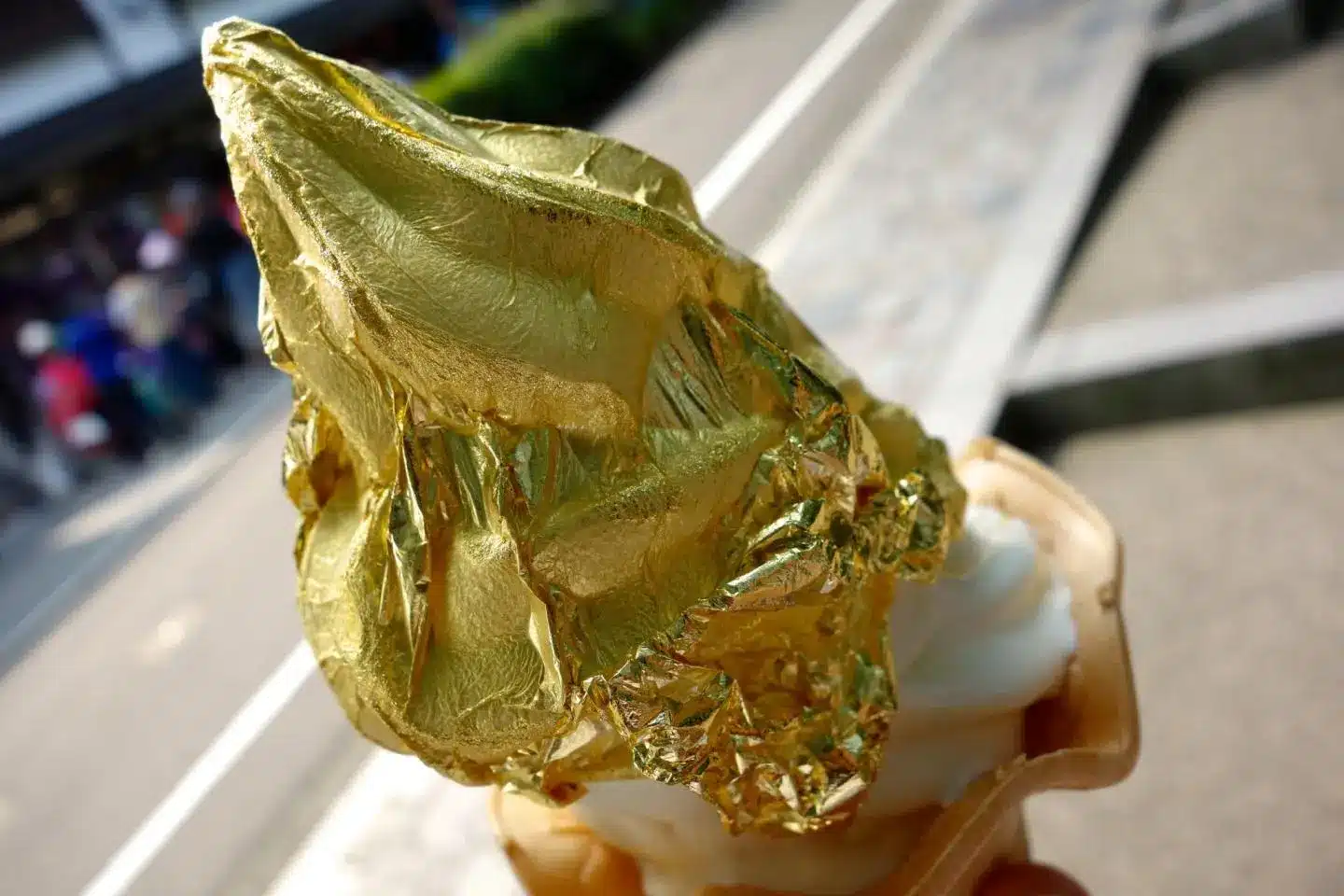
Gold Leaf, and a City Built on Making Things
Kanazawa produces 99 percent of Japan’s gold leaf and effectively all of its silver and platinum leaf, using a technique refined here since the Edo period, when the ruling Maeda family brought in artisans from across the country and gave the craft room to flourish. There’s a detail in that history worth sitting with, the gold leaf covering Kyoto’s own Kinkaku-ji, one of the most photographed buildings in Japan, was made in Kanazawa.
Gold leaf is only part of the picture. Kaga Yuzen, an intricate silk dyeing technique, and Kutani ware, distinctive ceramics that trace back to the seventeenth century, both still have working artisans producing new pieces rather than simply displaying old ones. This is a city where craft survived as a living economy rather than as something roped off in a museum case, and that distinction is easy to feel walking its streets even without setting foot in a workshop.
You can even enjoy gold leaf ice cream and cakes.
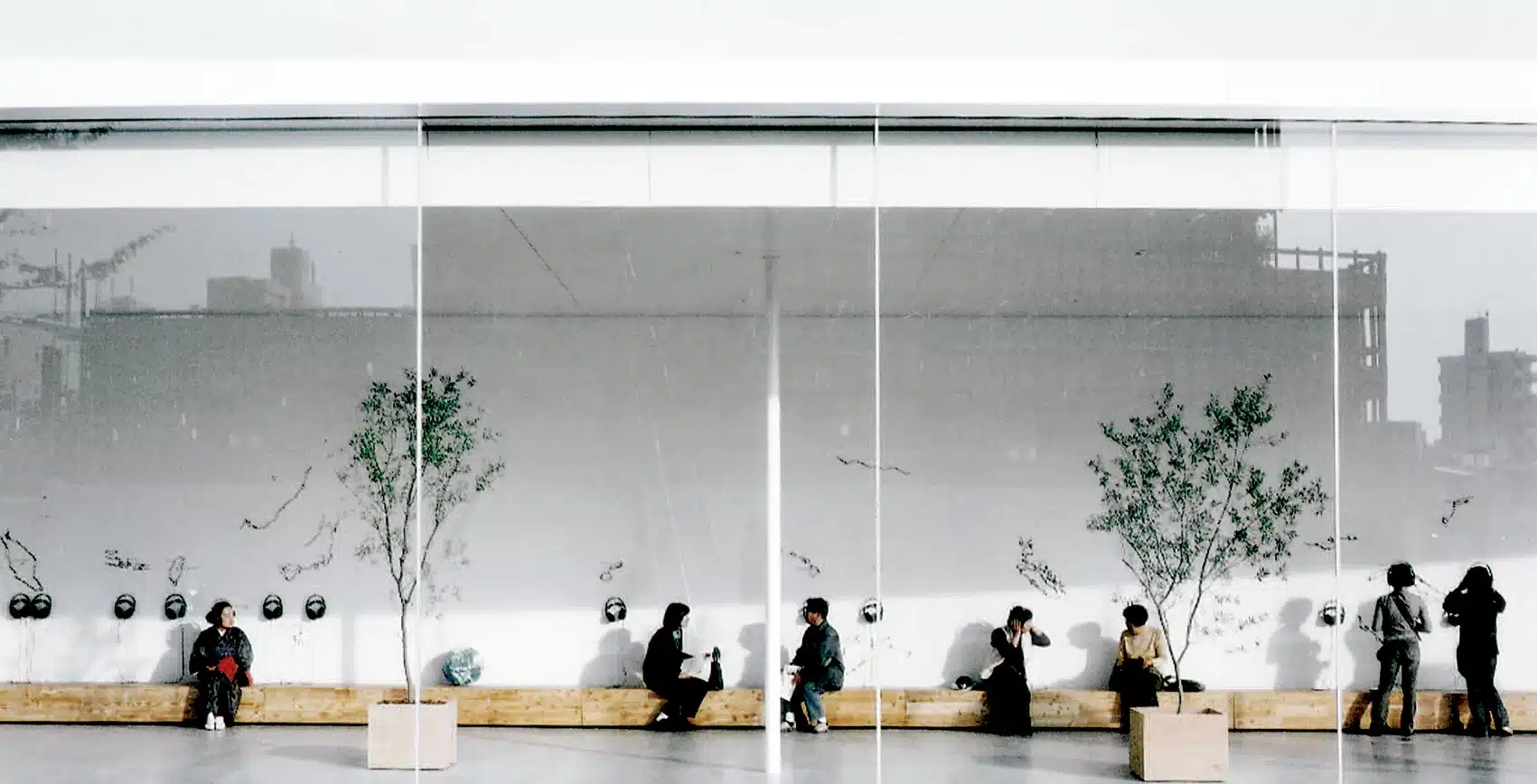
A Contemporary Art Museum Two Minutes From a Feudal Garden
The 21st Century Museum of Contemporary Art sits close enough to Kenrokuen that a visitor can walk from a three-hundred-year-old garden built for feudal lords into a circular glass building showing work by artists like Anish Kapoor and Olafur Eliasson in a matter of minutes.
Designed by the architecture firm SANAA and opened in 2004, the museum has drawn large enough crowds since to rank among the most visited art museums anywhere in the world, an unlikely statistic for a city this size. The juxtaposition itself is part of what makes Kanazawa memorable, not old versus new exactly, but old and new sitting close enough to trip over each other, with neither one feeling like the odd one out.
The City the Bullet Train Only Just Found
Kanazawa’s direct Shinkansen link to Tokyo only opened in 2015. Before that, reaching the city meant a longer, more deliberate journey, and Kanazawa spent most of its modern history somewhat outside the well-worn Tokyo-Kyoto-Osaka circuit that defines a first-time visitor’s Japan.
That recent connection explains a lot about how the city still feels to a lot of travelers arriving today. It isn’t a permanently hidden secret so much as a place still catching up to its own accessibility, still building the infrastructure and reputation that a decade of direct bullet train service hasn’t fully caught up to yet. Visiting now means seeing a version of Kanazawa that’s still mid-discovery rather than a well-trodden stop rebranded as an off-the-beaten-path find.
Omicho Market on a Tuesday Morning
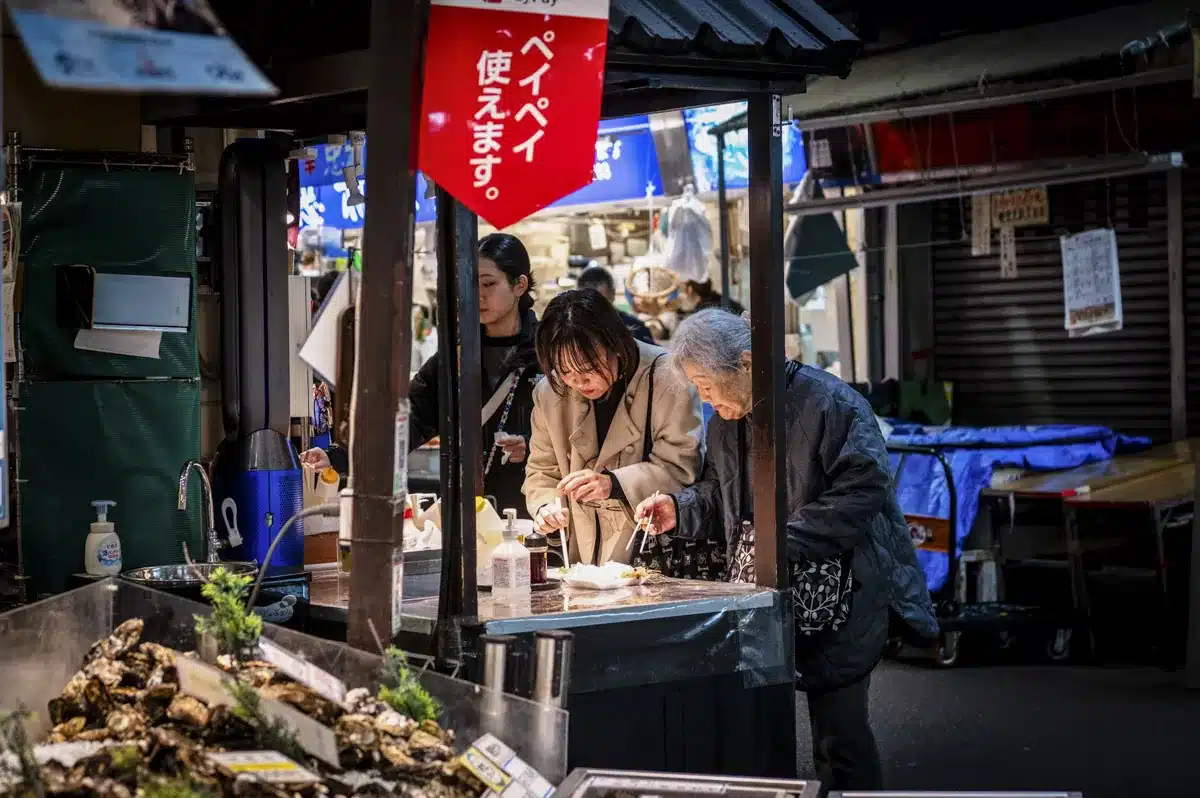
Omicho Market has run the city’s food supply for close to three hundred years, and it still does exactly that rather than performing the role for visitors. Vendors call out to regulars by name. Restaurant staff move through the stalls filling orders before the morning rush starts elsewhere in the city.
Walking through on an ordinary weekday morning, before the tour groups arrive, means watching a city actually run rather than watching a market dressed up to look like it does. That’s a different experience from a food hall built for tourism, and it’s part of what makes Kanazawa feel less like a set of attractions and more like a place people still live.
The Three Neighborhoods That Make Kanazawa Special
Kanazawa’s appeal comes down to three districts, and the fact that none of them sit far from the others.
Higashi Chaya is the geisha quarter, a single main street of two-story wooden machiya lined with dark kimusuko lattice screens, the kind that once let women inside watch the street without being seen from it. It’s compact enough to walk end to end in five minutes, though almost nobody does. The side alleys, quieter and less renovated than the main strip, are where the district actually rewards slowing down.
Nagamachi is the old samurai quarter, a short walk from Higashi Chaya on the opposite side of the city center. Ochre earthen walls, narrow lanes, and a working canal system mark out the former home ground of the Maeda clan’s retainers, the Nomura Residence chief among the houses still open to visitors.
Omicho itself is the neighborhood anchoring the center between them, built around the market that gives the district its name, the same working market covered above, still supplying restaurants and still busiest early in the morning before the crowds arrive.
What makes the three work together is geography as much as content. A visitor can walk from samurai lanes to a working market to a geisha district in a single unhurried day, something close to impossible in a city the size of Kyoto, where the same three categories of sight sit scattered across an area many times larger.
Kanazawa's Geisha Districts Are Still Living Communities
Kanazawa has three preserved chaya districts, and the distinction between them says something Kyoto’s single, overwhelmed Gion district can no longer say as clearly.
Higashi Chaya is the largest and most visited, its geisha houses old enough that some, including the roughly two-hundred-year-old Shima house, are now open to the public as museums. Nishi Chaya, smaller and further from the center, draws a fraction of the visitors. Kazue-machi, the smallest of the three, sits along the Asano River and holds perhaps twenty households packed into a real tangle of alleyways, more residential than performative even now.
The architecture itself marks these as different from Kyoto’s version of the same tradition. During the Edo period, two-story buildings were banned everywhere in the city except for chaya, which is why the lattice-fronted upper floors stand out the way they do. The overall palette runs darker and plainer than Gion’s, muted wood tones rather than the bright reds and yellows of Kyoto’s teahouse district, a difference locals attribute partly to climate and partly to a simply different aesthetic instinct.
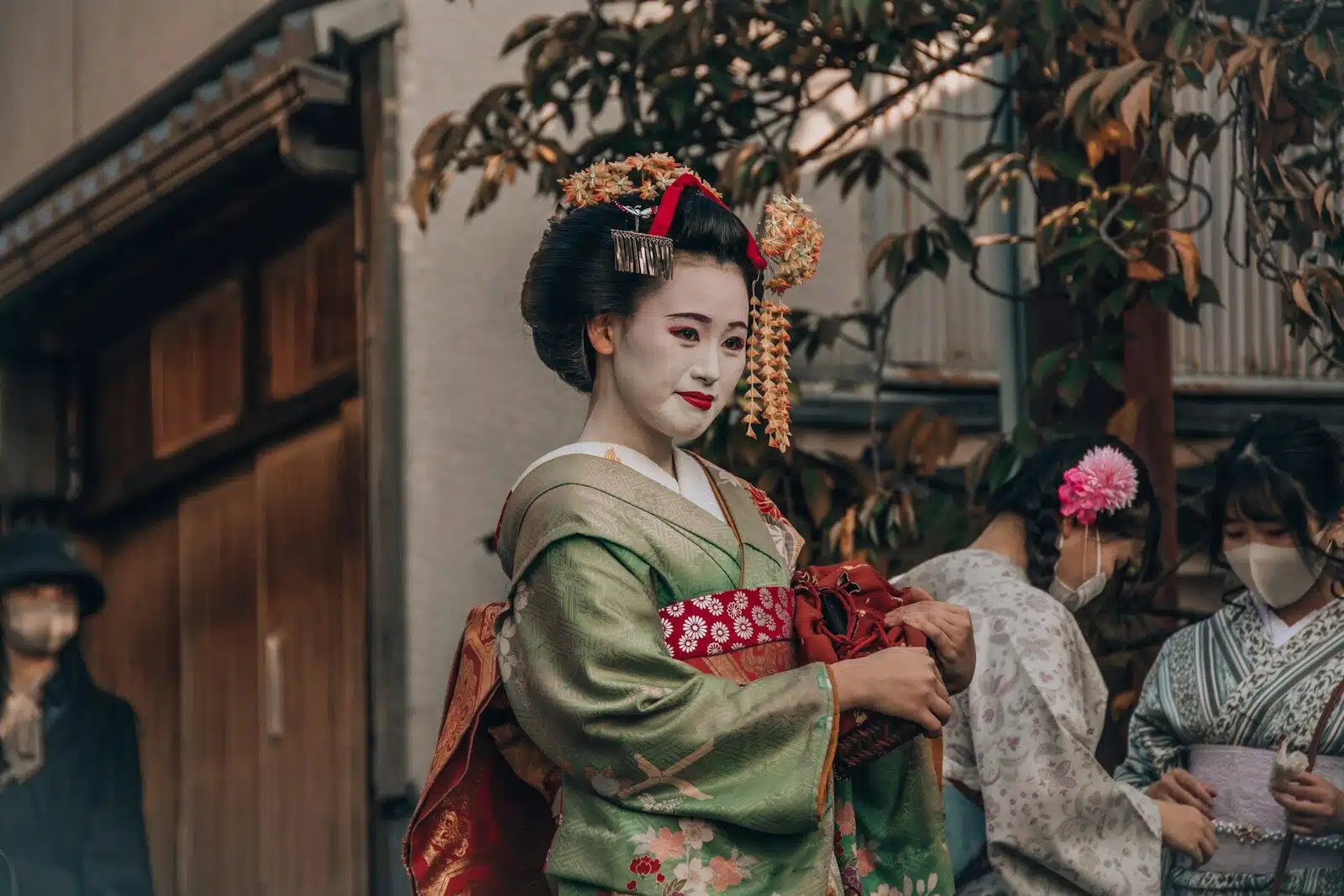
An estimated forty geiko are still active in the city today, and Kanazawa has made a deliberate civic effort to keep the tradition alive rather than simply preserve the buildings it lives in.
Spotting a geiko on the street on the way to an appointment is possible but rare, and there’s no reliable corner to stand on and wait for one. That rarity is itself the point. Kyoto’s Gion now sees so much tourist traffic that hired performers in rented costumes have become the default photo opportunity for most visitors passing through. Kanazawa’s chaya districts, quieter and considerably less photographed, still function closer to what they were originally built for.
Getting to Kanazawa
From Tokyo, the Hokuriku Shinkansen runs direct to Kanazawa in about two and a half hours, stopping at Nagano and Toyama along the way, no transfer required.
From Kyoto or Osaka, there’s no direct train. The route runs via the Thunderbird limited express to Tsuruga, then a transfer onto the Hokuriku Shinkansen for the final stretch, a journey of a little over two hours in total. It’s a straightforward connection rather than an inconvenient one, and it makes pairing Kanazawa with a Kyoto or Osaka leg of a trip easy to build into a single itinerary rather than a detour that demands its own justification.
Komatsu Airport, a short bus ride from the city center, offers a smaller number of domestic connections for travelers coming from elsewhere in Japan, though most visitors arrive by rail.
However a trip gets there, the point stands regardless of route. Kanazawa rewards the extra step required to reach it, and for a city this easy to fold into an existing itinerary, that step has become smaller every year since the Shinkansen link opened.