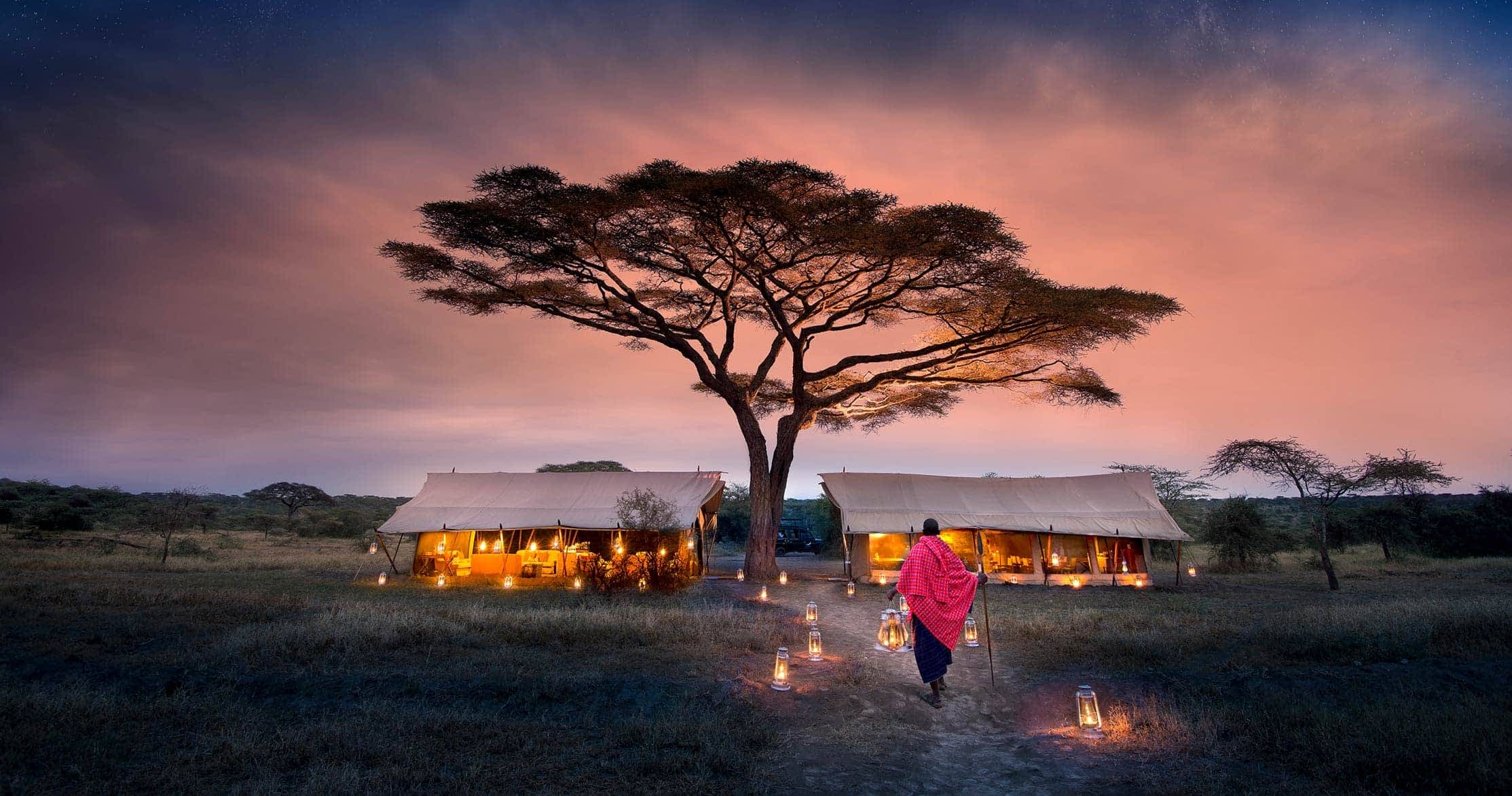


A night in a mobile camp positioned for the Great Migration’s current season offers proximity to one of the largest wildlife movements on Earth, with no fixed route or schedule. The camp itself relocates throughout the year to stay near the herds, rather than waiting for them to arrive.
Each year, roughly two million wildebeest, zebra, and gazelle move in a continuous clockwise circuit across the Serengeti-Mara ecosystem, following the rains in search of fresh grazing. There is no single migration event with a beginning or end. It simply continues, season after season, in a pattern shaped by weather rather than the calendar.
A handful of camps exist specifically to follow this movement, relocating their entire setup between the southern and northern Serengeti as the herds shift through the year. Staying in one of these camps means sleeping somewhere chosen for its proximity to the herd’s current location, rather than a single, permanent spot on the map.
What that location offers changes depending on when you visit: sweeping plains thick with newborn calves in one season, dramatic river crossings in another.

About Do Not Disturb
Do Not Disturb is a luxury travel company specializing in carefully designed journeys and considered experiences. Each itinerary we build for our clients is informed by real destination knowledge, offering insight into places, cultures, and moments that shape how a trip comes together.
If this destination has sparked ideas, the itinerary can be developed into a private journey tailored to your interests and travel style, with hand-picked stays, thoughtful routing, and experiences curated around what matters most to you.
Cultural & Historical Context
The migration’s clockwise route runs roughly 800 kilometers a year, beginning with the wildebeest calving season in the southern Serengeti, continuing north through the Serengeti’s central and western reaches, crossing into Kenya’s Maasai Mara during the dry months, and returning south again as the rains shift. The route has stayed broadly consistent for generations, shaped by rainfall patterns rather than any fixed schedule, which is part of why no single safari can promise an exact location on a given date.
Mobile migration camps emerged as a direct response to this unpredictability. Rather than building a permanent lodge in one location and hoping the herds pass nearby, operators developed camps designed to be dismantled and rebuilt elsewhere, typically moving between the southern plains during calving season and the northern reaches during the dry season’s river crossings. The camp itself becomes part of the migration’s rhythm, repositioning roughly twice a year to stay within reach of the herd’s general movement.

Why Private or Small-Group Access Matters
A fixed lodge offers comfort and consistency, but no control over where the herds happen to be during your stay. A mobile camp shifts that balance considerably, since its entire purpose is staying within range of the migration’s current phase.
Camps built around this model also tend to run with limited tents and small guest numbers, prioritizing an intimate, low-impact setup over scale. Game drives are guided by specialists who track the herd’s movement daily, adjusting routes based on where the action actually is rather than a fixed circuit.
The result is a closer, more responsive relationship with the landscape itself, one built around following events as they unfold rather than visiting a static viewpoint.

What You Experience
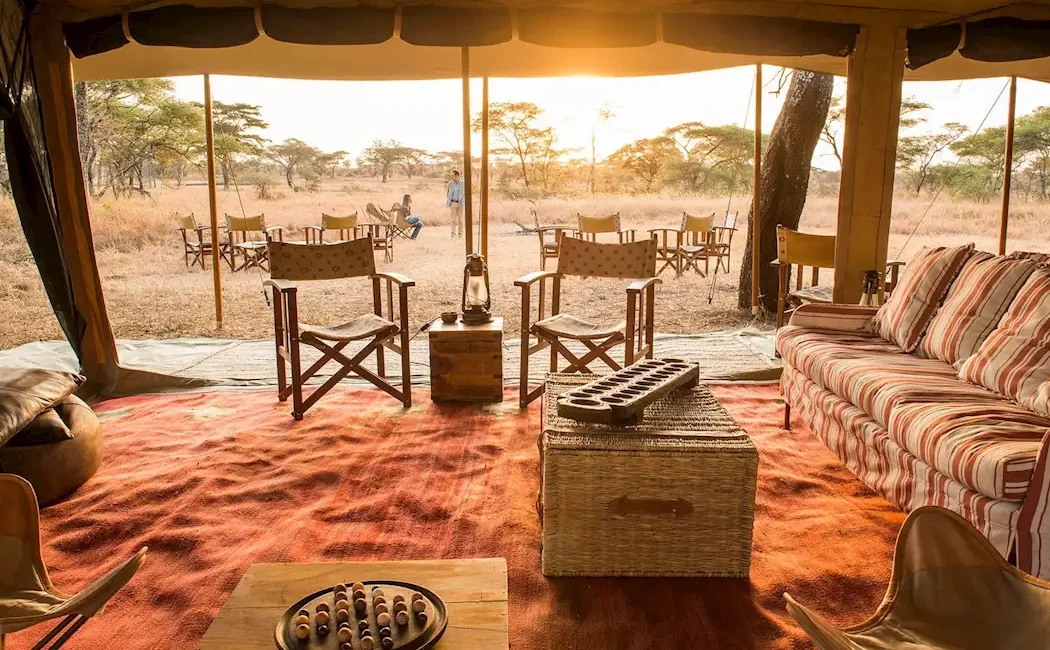
Arrival typically means a tented camp positioned on a rise or open stretch of plain, chosen specifically for its view over the surrounding grassland. Days are built around two guided game drives, timed around the cooler hours of early morning and late afternoon, when wildlife activity tends to peak.
What you encounter on those drives depends entirely on the season. During the calving months in the southern plains, the landscape fills with newborn wildebeest calves and the predators that follow them, a concentration of life and risk playing out across open grassland in full view. During the dry months further north, the same camps reposition near river crossing points, where herds gather in their thousands before committing to the crossing itself, often with crocodiles waiting below.
Camp life unfolds at a slower pace between drives. Meals are taken in an open-sided dining tent overlooking the plains, with the day’s sightings inevitably becoming the main subject of conversation. Evenings often include a sundowner drink as the light fades, followed by dinner under canvas.
Nights bring their own particular atmosphere. Without solid walls or surrounding development, the sounds of the bush carry directly into camp: lions calling across the plains, hyenas nearby, occasionally the heavier movement of elephants passing close to the tents. None of this is staged or guaranteed; it is simply what happens when a camp sits inside, rather than beside, an active wildlife landscape.
How Do Not Disturb Makes This Possible
Do Not Disturb selects and books the specific mobile camp and dates best aligned with the migration’s seasonal position at the time of your visit, working directly with operators who track the herd’s movement throughout the year. Transfers, timing, and the wider shape of your Tanzania itinerary are coordinated around this single, carefully positioned stay.
Expectations are also set honestly from the outset. No safari can guarantee an exact sighting on a specific date, and Do Not Disturb works to position you in the right region during the right season, rather than promising a precise location no operator can control.
A night in a migration camp offers no fixed image to expect in advance. What stays with most travelers is not a single sighting but the broader sense of having slept inside a landscape still actively shaping itself: a place where the wildlife outside the tent is moving for reasons that have nothing to do with your visit and everything to do with rain that fell somewhere else weeks earlier.
Plan your own version of this journey
Speak to Do Not Disturb’s luxury travel experts and turn this moment into something personal.
Suggested articles
Where to Go On Honeymoon? A Guide to Help You Choose
Wilderness to Waves: Luxury Honeymoons in Kenya
Why Botswana Is Africa’s Most Exclusive Safari Destination

Serengeti to Shore: Honeymoons in Tanzania and Zanzibar
Tanzania vs. Botswana: Which African Safari Should You Choose?

Serengeti vs. Maasai Mara: Which Luxury Safari Is Right for You?

The Okavango Delta: Africa’s Most Unique Safari Destination

Okavango Delta vs. Kruger National Park: Which Safari Is Right for You?

Best Winter Sun Honeymoon Destinations in Europe
Portugal vs Spain for Your Honeymoon – Which Should You Choose?
One Island or Two? Splitting Your Maldives Honeymoon Between Resorts

Italy vs Greece for Your Honeymoon – Which is Better?
48 Hours in Lima: Where to Eat, Stay and Explore