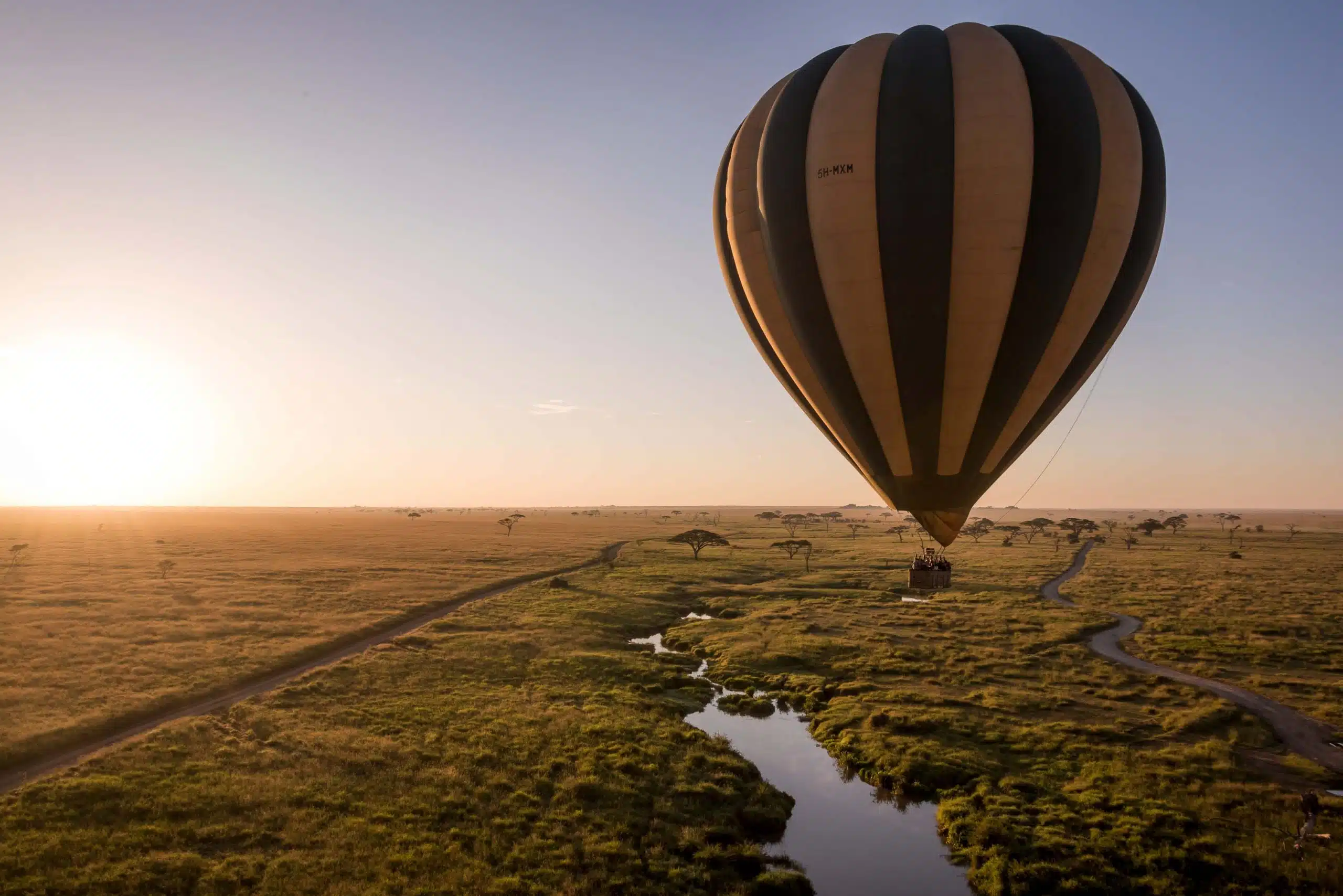

A private hot air balloon over the Masai Mara at dawn, timed around the wildebeest migration. Below, the herds spread across the plains in a way that only becomes visible from above. An hour in the air, followed by a champagne breakfast on the plains where the balloon lands.
The Masai Mara covers 1,510 square kilometers of southwestern Kenya and forms the northern corridor of the Serengeti-Mara ecosystem, where over 1.5 million wildebeest migrate annually between July and October.
A balloon flight at dawn, when the light is low and the wildlife is at its most active, produces a perspective on that movement that no time in a vehicle on the ground can provide. The flight lasts around one hour.
Departure is timed for first light, typically around 5:30am, with a pre-dawn transfer from camp to the launch site. The balloon inflates as the crew prepares for takeoff and the basket lifts off as the sun begins to clear the horizon.
From that point, the Mara spreads out below in every direction, the Mara River winding through the plains, the escarpment marking the edge of the ecosystem to the west, and during migration season, the herds moving across the grassland in lines that extend to the limit of visibility.

About Do Not Disturb
Do Not Disturb is a luxury travel company specializing in carefully designed journeys and considered experiences. Each itinerary we build for our clients is informed by real destination knowledge, offering insight into places, cultures, and moments that shape how a trip comes together.
If this destination has sparked ideas, the itinerary can be developed into a private journey tailored to your interests and travel style, with hand-picked stays, thoughtful routing, and experiences curated around what matters most to you.
Cultural and Historical Context
The Masai Mara National Reserve was established in 1961 and covers the core of the ecosystem on the Kenyan side, with surrounding Maasai-managed conservancies extending the habitat and producing some of the most productive game viewing in the broader ecosystem.
Hot air balloon flights over the Mara have been operated since the 1970s, when the first commercial safaris launched from what is now Governors’ Camp. The tradition of ending a flight with a champagne bush breakfast on the plains dates to that era.
The wildebeest move in a circular route between the Serengeti in Tanzania and the Masai Mara in Kenya, following the seasonal rains and the grass they produce. The crossing of the Mara River, which the herds must navigate multiple times during the migration, is the most documented moment in the cycle, with crocodiles waiting in the water and predators following on land.

Why Private or Small-Group Access Matters
A standard shared balloon in the Masai Mara carries up to 16 passengers in a basket divided into four compartments. The pilot manages the interests of 16 people simultaneously, which means the balloon moves to cover ground rather than pausing over what any one person wants to watch.
A private balloon carries two to four passengers. The pilot’s attention is entirely on what is below. If a lion is hunting on the plain beneath, the pilot can hold position. If a river crossing is beginning half a kilometer to the east, the balloon can move toward it. The silence that the migration produces from above, thousands of animals moving across open grass, is experienced as silence rather than as a backdrop to the conversation of strangers.
The champagne breakfast that follows is served at the landing site, wherever the wind has carried the balloon, on the plains away from any camp or road. With a private flight, the location, the timing, and the breakfast itself are organized around the people sitting at the table rather than around a group of sixteen.

What You See
From a height of 1,000 feet, the scale of the Mara becomes visible in a way that no game drive communicates. The plains extend to every horizon and the Mara River cuts through the landscape below. During migration season, the lines of wildebeest moving in formation across the grass read as organized and deliberate from above in a way they do not from the ground.
Without engine noise, the wildlife does not react to the balloon the way it reacts to a vehicle. Lion prides stay where they are. Elephant move along their routes without altering pace. Hippo surface in the river below. The absence of noise and movement produces proximity to behavior that a game drive interrupts simply by being present.
The light at dawn changes the landscape across the course of the flight. The grass shifts from brown to gold as the sun rises, the shadow of the balloon tracking across the plains below. The Mara River moves from black to copper to silver across the hour in the basket.

How Do Not Disturb Makes This Possible
Do Not Disturb works with a small number of balloon operators in the Mara whose standards of piloting, safety, and service are consistent with a private flight experience. The timing of the flight is planned around the migration cycle, the weather patterns of the specific week, and the location of the herds at the time of the visit.
In peak migration season, from July through October, the window for the best crossing activity shifts daily depending on where the herds are concentrating and where the river is most likely to be crossed.
Ready to plan your private balloon flight over the Masai Mara and experience the wildebeest migration from above? Speak with Do Not Disturb to begin your journey.
Plan your own version of this journey
Speak to Do Not Disturb’s luxury travel experts and turn this moment into something personal.
Related destinations
Suggested articles
Where to Go On Honeymoon? A Guide to Help You Choose

Why Kenya Is Perfect for a Luxury Honeymoon
Wilderness to Waves: Luxury Honeymoons in Kenya

Kenya vs. South Africa for a First Safari

Serengeti vs. Maasai Mara: Which Luxury Safari Is Right for You?

Best Winter Sun Honeymoon Destinations in Europe
Portugal vs Spain for Your Honeymoon – Which Should You Choose?
One Island or Two? Splitting Your Maldives Honeymoon Between Resorts

Best Honeymoon Destinations for Autumn

Italy vs Greece for Your Honeymoon – Which is Better?
48 Hours in Lima: Where to Eat, Stay and Explore

A Cultural Honeymoon in Peru: Machu Picchu, Cusco, the Sacred Valley and the Amazon

Peru or Mexico: Which Ancient Civilization Should You Visit First?