
On this page
Venice holds more art per square meter than almost any city in Europe, much of it inside buildings most visitors never enter. This guide covers the canonical interiors alongside the collections that demand closer attention.
How to Read Venice as an Art City
Venice does not concentrate its art in a small number of institutions. It distributes it across the buildings that have always held it, parish churches, confraternity halls, ducal apartments, and private palazzi. Many of the city’s most significant works remain in the architectural contexts for which they were commissioned, making the experience of seeing them inseparable from understanding the buildings themselves.
The city’s art geography follows its social history. The scuole grandi, lay confraternities with considerable civic power, commissioned major programmes from Tintoretto, Carpaccio, and Tiepolo. The church of the Frari alone contains works by Titian, Bellini, and Canova. This distribution reflects how patronage, civic identity, and religious life operated in Venice across several centuries.
An art-focused visit requires a different orientation than a museum itinerary. Access to many interiors is restricted, seasonal, or dependent on prior arrangement, and the sequence in which sites are visited matters, as Venice’s art history is cumulative and cross-referential across neighbourhoods and building types.
The Palaces: Art in Private Hands
The Gallerie dell’Accademia holds the most complete survey of Venetian painting in existence, tracing the tradition from Byzantine altarpieces through to Titian, Veronese, and Tiepolo. The collection is housed in a former scuola and convent complex, and the architecture itself reflects the civic and religious structures through which Venetian art was historically commissioned and displayed.
Ca’ Rezzonico documents a later period, the 18th-century patrician interior at its most elaborate. The palace contains ceiling frescoes by Tiepolo, period furniture, and a sequence of rooms that illustrate how Venetian noble families used art as a form of social and political self-presentation. The building was never subdivided or repurposed in ways that stripped its original character, which makes it unusually coherent as a period document.
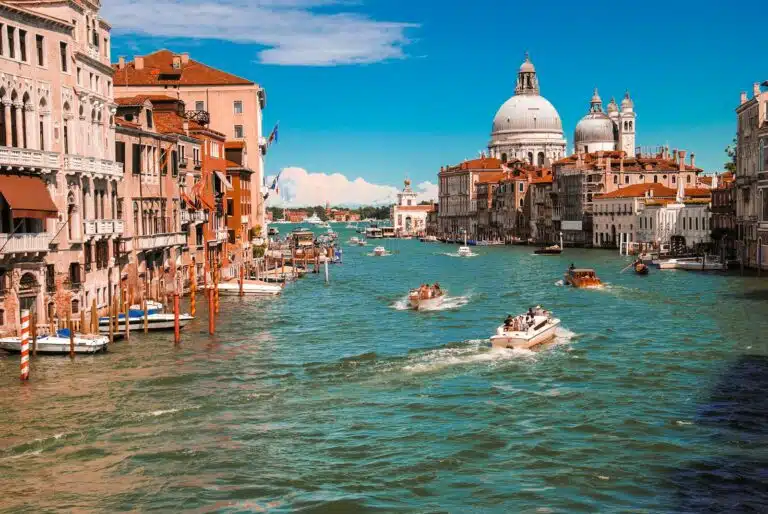
Ca’ Pesaro takes a different position, housing the city’s modern art and Oriental art museums within a Longhena-designed facade on the Grand Canal. The collection reflects Venice’s engagement with international modernism during the late 19th and early 20th centuries, a period less commonly associated with the city.
The Churches as Galleries
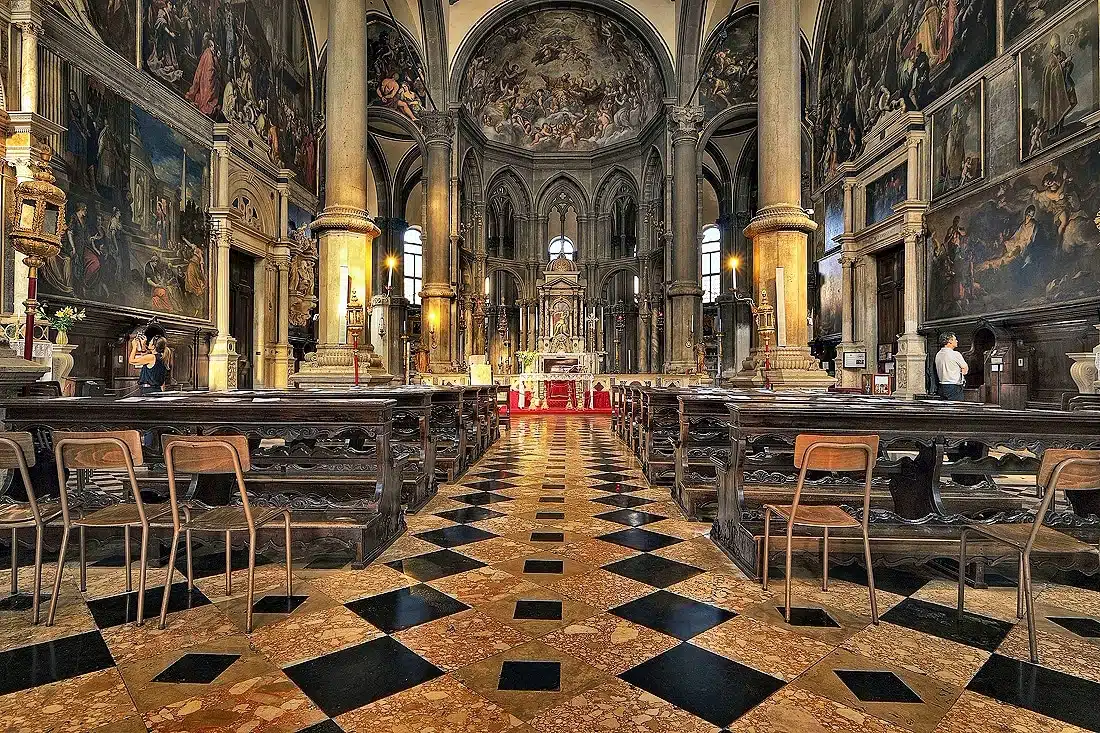
The Frari, San Zaccaria, and San Sebastiano are primary sites where major works remain in the settings for which they were originally made. Titian’s Assumption of the Virgin in the Frari is the clearest example. The painting was designed to be seen from the nave, with its scale and colour calibrated to the specific distance between the high altar and the congregation.
San Zaccaria holds Bellini’s altarpiece of the Virgin and Child with Saints, completed in 1505 and still in its original position. The work is considered one of the most resolved examples of the Venetian sacra conversazione format, with saints and the Madonna gathered in a single unified space, and its placement within the church is part of its compositional logic.
San Sebastiano is the most concentrated of the three. Veronese decorated its ceiling, nave, and sacristy across several decades, making the church a sustained study in how a single artist structured a devotional interior. Entry is managed, and access is not always straightforward.
The Scuole: Civic Art Beyond the Tourist Circuit
The scuole grandi were Venice’s lay confraternities, civic institutions that commissioned art as a form of collective identity and public devotion. Their interiors were not decorative exercises but sustained programmes, and two in particular represent some of the most concentrated figurative work in the city.
The Scuola Grande di San Rocco contains Tintoretto’s largest and most ambitious cycle, covering the walls and ceilings of three rooms across several decades of work. The scale is architectural rather than ornamental, and the programme moves through Old and New Testament subjects with a structural logic that rewards close attention. It remains one of the least diluted Renaissance interiors in Venice.
The Scuola di San Giorgio degli Schiavoni, known as the Scuola Dalmata, houses Carpaccio’s cycle depicting Saints George, Tryphon, and Jerome, completed in the early sixteenth century. The rooms are small, and the works remain in their original setting, which is increasingly rare in Venice and materially affects how the cycle reads.
Private Views and Contemporary Access
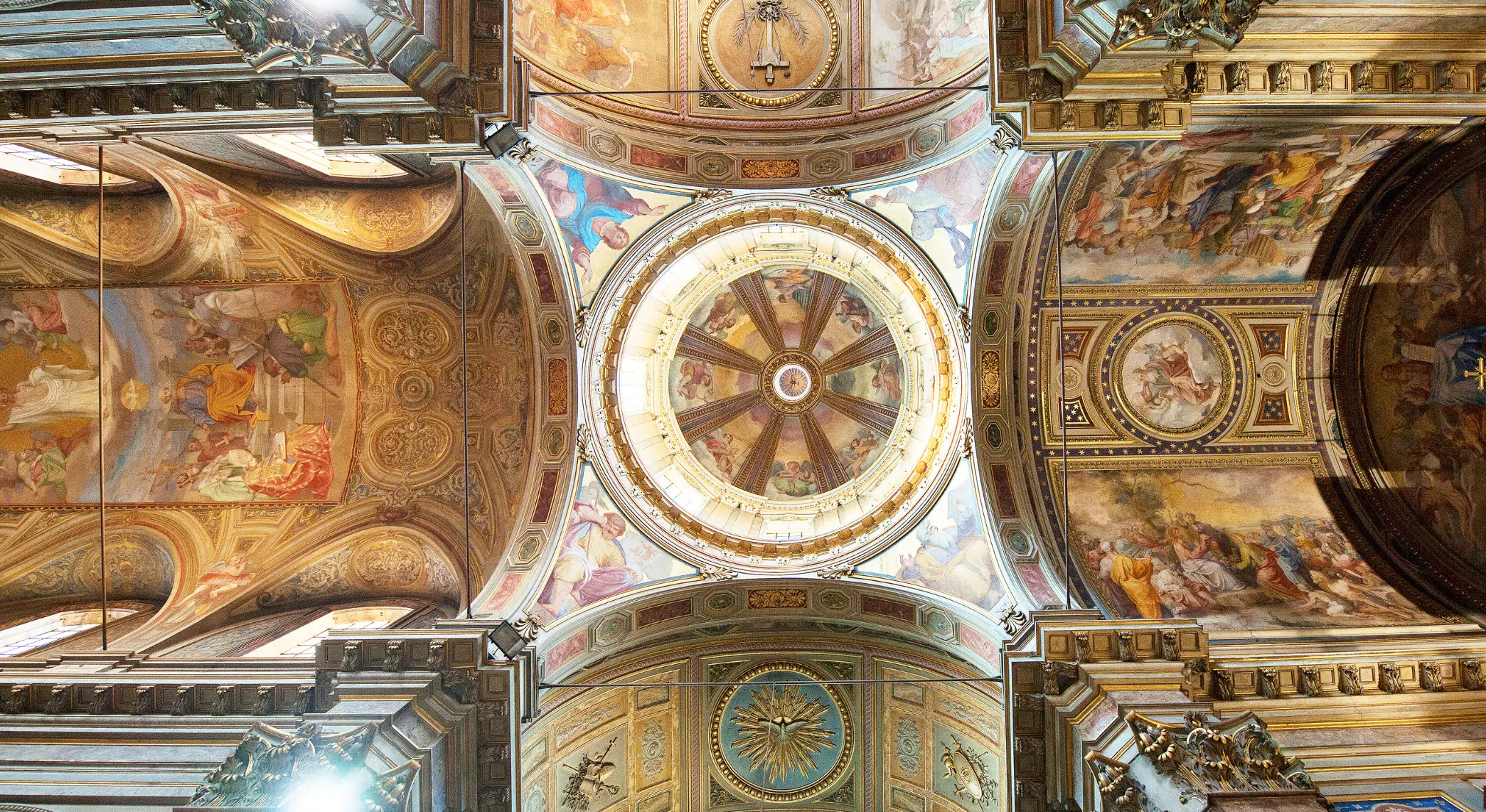
Venice’s most significant contemporary collections are held not by public museums but by private foundations, several of which occupy historic buildings that carry their own architectural and civic importance. Punta della Dogana, the former customs house at the tip of Dorsoduro, operates as an exhibition space for the Pinault Collection, rotating major works from one of Europe’s most substantial holdings of contemporary art.
Fondazione Querini Stampalia combines a functioning library, a permanent collection of Venetian paintings, and a ground floor redesigned by Carlo Scarpa, making it one of the few spaces in the city where historic and modern intervention are genuinely integrated.
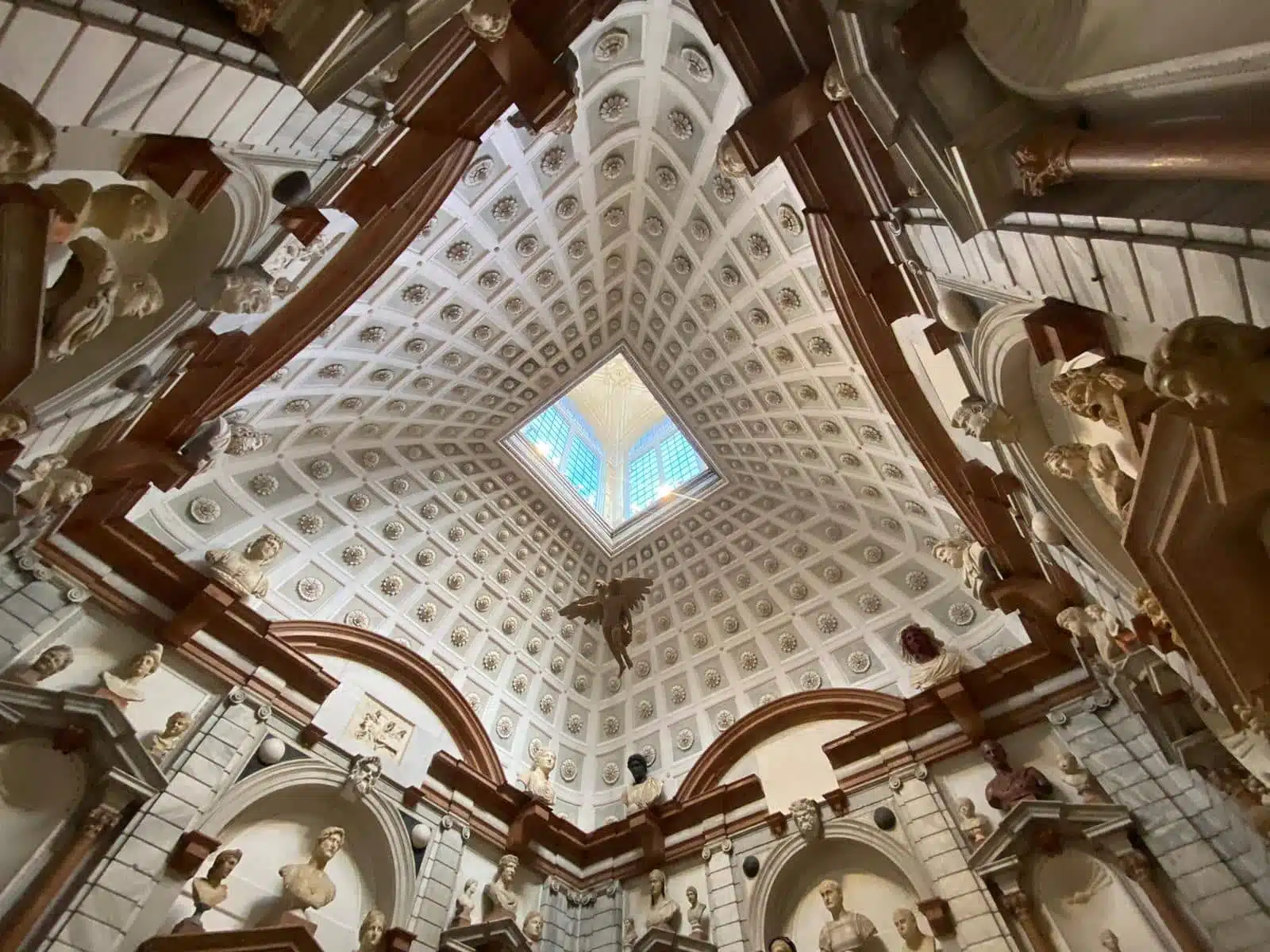
Palazzo Grimani, a Renaissance palace near Santa Maria Formosa, holds a permanent collection of classical antiquities within rooms that were themselves designed to display them, a rare instance of original context surviving intact. Access to foundation programming, private views, and collection-specific visits varies considerably and depends on how the visit is structured.
Planning an Art-Focused Visit
Late autumn and early spring offer the most practical conditions for an art-focused visit. Crowds thin significantly after October, and the city’s smaller institutions, including the oratories and private foundations, are easier to navigate without competing for space or time. The Biennale years, alternating between art and architecture, affect both availability and pricing across the city and are worth factoring into timing.
Venice divides into six sestieri, each with a distinct concentration of sites. A logical itinerary moves from Dorsoduro, which holds the Accademia, the Punta della Dogana, and several significant churches, across to San Polo and Santa Croce before addressing Cannaregio and Castello on separate days. San Marco warrants its own half-day, separate from the Doge’s Palace visit.
Access to restricted collections, including private palaces and closed conventual spaces, is not straightforwardly available to independent visitors. The most significant interiors require advance coordination through contacts with established relationships in the city, and the quality of access reflects the depth of those relationships.
Venice’s most significant works are worth appreciating in the settings for which they were made.