A private dinner on the rim of the Ngorongoro Crater offers a secluded way to experience one of Africa’s most extraordinary landscapes. This is one of Tanzania’s most established safari rituals, reshaped entirely around your own table, timing, and pace.
The Ngorongoro Crater is the world’s largest intact volcanic caldera, a vast bowl of grassland and forest formed when an ancient volcano collapsed in on itself several million years ago. Its walls now enclose one of the densest concentrations of wildlife found anywhere in Africa.
The descent road into the crater closes by late afternoon, and the vehicles that spent the day on the caldera floor begin their climb back toward the rim. As the light starts to soften, a different kind of evening begins above them.
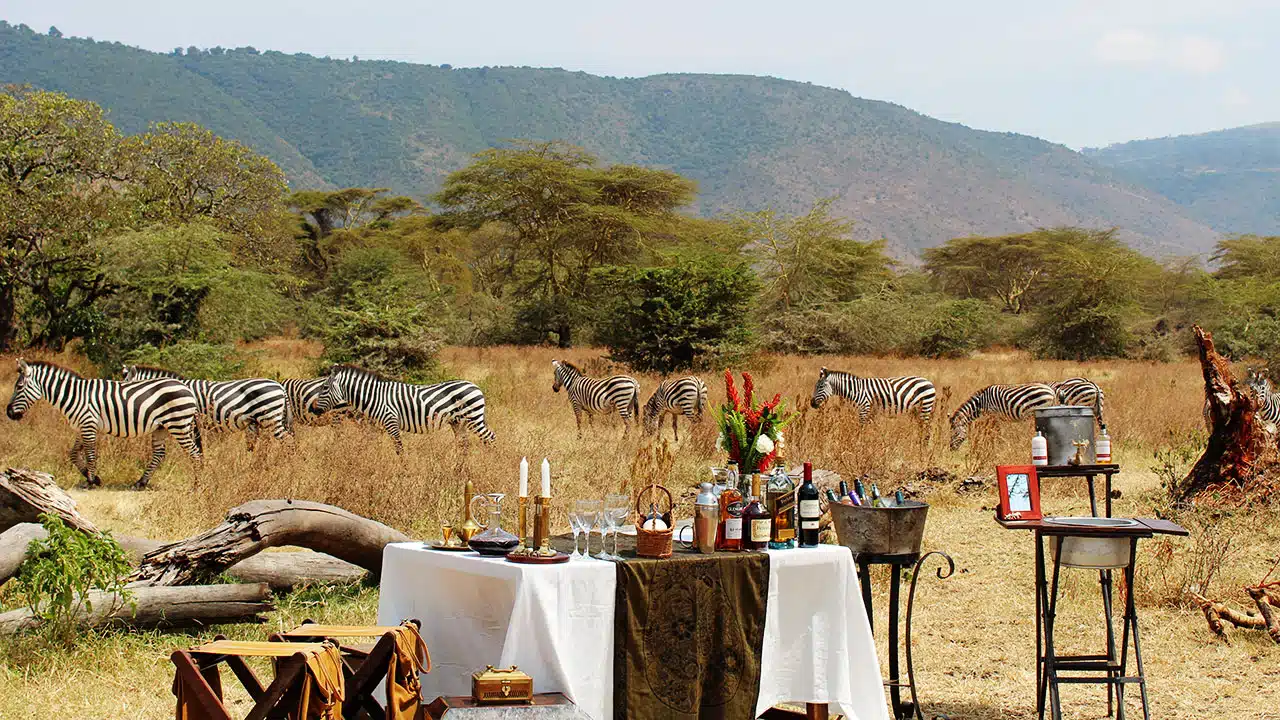
A vehicle collects you from your lodge and follows a quiet track along the crater’s edge, away from the lodge grounds and any other guests. The spot has already been chosen for its view of the caldera below and its position relative to the setting sun.
By the time you arrive, the table is set. A fire is already burning. There is nothing left to do except sit down and take in your surroundings.

About Do Not Disturb
Do Not Disturb is a luxury travel company specializing in carefully designed journeys and considered experiences. Each itinerary we build for our clients is informed by real destination knowledge, offering insight into places, cultures, and moments that shape how a trip comes together.
If this destination has sparked ideas, the itinerary can be developed into a private journey tailored to your interests and travel style, with hand-picked stays, thoughtful routing, and experiences curated around what matters most to you.
Cultural & Historical Context
The bush dinner descends from a tradition that took shape during the earliest East African safaris of the 1920s, when an evening of drinks and dining in the open air became one of the defining rituals of travel through this region. The format has barely changed since: a fire, a clear sky, and a table set somewhere with a view worth the effort of reaching it.
The Ngorongoro Conservation Area carries a significance beyond its wildlife. It is one of the few places in Tanzania where the Maasai people continue to live within a protected landscape, herding cattle across land that also supports one of the densest concentrations of large mammals in Africa. An evening built around Maasai music and dance is not a staged addition; it reflects a relationship between people and land that has shaped this place for generations.
The crater itself adds a final layer of context. Formed when a volcano larger than Kilimanjaro collapsed inward several million years ago, it now functions as a self-contained ecosystem, its walls holding in a level of wildlife density rarely matched anywhere else on the continent. Few dinner views anywhere carry this much geological and ecological weight.

Why Private Access Matters
A bush dinner at most lodges is run as a shared evening, scheduled to a fixed date during the dry season, and built around a minimum group size. Other travelers, often strangers to one another, are seated at the same table, working through the same set menu, on the lodge’s timetable rather than yours.
A private version removes that structure. There is no minimum headcount, no shared seating, and no fixed script for how the evening unfolds. The site is chosen specifically for your stay, and the performance, when it begins, plays to your table only.
This also changes the pacing. Without a wider group to manage, dinner can move as slowly as you like. A long pause between courses, an extended conversation with the dancers once the music ends, or simply more time watching the crater disappear into darkness are all possible when nobody else’s evening depends on staying on schedule.

What You Experience
The setting itself does most of the work. From the rim, the crater floor falls away in a single uninterrupted sweep, ringed by walls that rise nearly two thousand feet on every side. At this hour, the light moves quickly. What begins as a wash of gold across the grassland gives way within an hour to deep blue, then black, the last visible movement on the floor below fading well before dinner is served.
Your table sits a short distance from the fire, set with cloth, glassware, and the kind of detail that survives the journey out from the lodge intact. A full bar is arranged nearby, stocked for the evening rather than rationed for a group. The first hour passes slowly: a drink in hand, the temperature dropping as the equatorial sun disappears with unusual speed, the fire doing most of the work of warmth and light.
Maasai dancers and singers arrive as the sky finishes changing color. Their performance is built around traditional chants, rhythmic jumping displays, and call-and-response singing that has accompanied ceremonies and gatherings in this region for generations. Performed for a single table rather than a crowded terrace, the scale of it shifts. Voices carry differently in the open air when there is no competing noise, and the space between performers and audience narrows considerably.
Dinner follows, prepared over an open charcoal grill a short distance from your table. A five-course meal moves through a selection of grilled meats, fish, and vegetarian dishes, accompanied by salads, fresh fruit, and dessert. Courses arrive at intervals timed to the conversation rather than the kitchen, plates returning to the fire only when your table is ready for the next stage.
By the final course, full darkness has settled over the crater. Away from any other light source, the stars over the rim are some of the clearest available anywhere in East Africa, the sky dense in a way that takes most visitors by surprise on their first night. Conversation tends to slow here, attention drifting upward rather than back to the table.
The return drive to your lodge closes the evening at whatever pace feels right. Some choose to linger by the fire well past the final course. Others are ready to move once dessert ends. Either way, your vehicle awaits your signal.
How Do Not Disturb Makes This Possible
Do Not Disturb arranges this evening as a fully private experience, working directly with the lodge to remove the standard minimum group size and shared seating that define the typical bush dinner. The site along the rim of the crater, the timing relative to sunset, and the menu are all coordinated in advance around your stay, your dietary requirements, and the broader shape of your time in Tanzania.
Transfers to and from the site, setup of the table and fire, and coordination with the performers are handled entirely in advance. Nothing on the day requires your attention beyond arriving and deciding when the evening ends.
A bush dinner on the Ngorongoro rim is memorable in almost any form. Arranged privately, it becomes something closer to a held breath: one table, one fire, and one of the largest intact volcanic craters on Earth fading into darkness in front of you.
Plan your own version of this journey
Speak to Do Not Disturb’s luxury travel experts and turn this moment into something personal.
Related destinations
Suggested articles

Serengeti to Shore: Honeymoons in Tanzania and Zanzibar
Tanzania vs. Botswana: Which African Safari Should You Choose?

Serengeti vs. Maasai Mara: Which Luxury Safari Is Right for You?

Best Winter Sun Honeymoon Destinations in Europe
Portugal vs Spain for Your Honeymoon – Which Should You Choose?
One Island or Two? Splitting Your Maldives Honeymoon Between Resorts

Best Honeymoon Destinations for Autumn

Italy vs Greece for Your Honeymoon – Which is Better?
48 Hours in Lima: Where to Eat, Stay and Explore

A Cultural Honeymoon in Peru: Machu Picchu, Cusco, the Sacred Valley and the Amazon

Peru or Mexico: Which Ancient Civilization Should You Visit First?
The Best Time to Visit Machu Picchu for Fewer Crowds
Why So Many Travelers Fall for Kanazawa