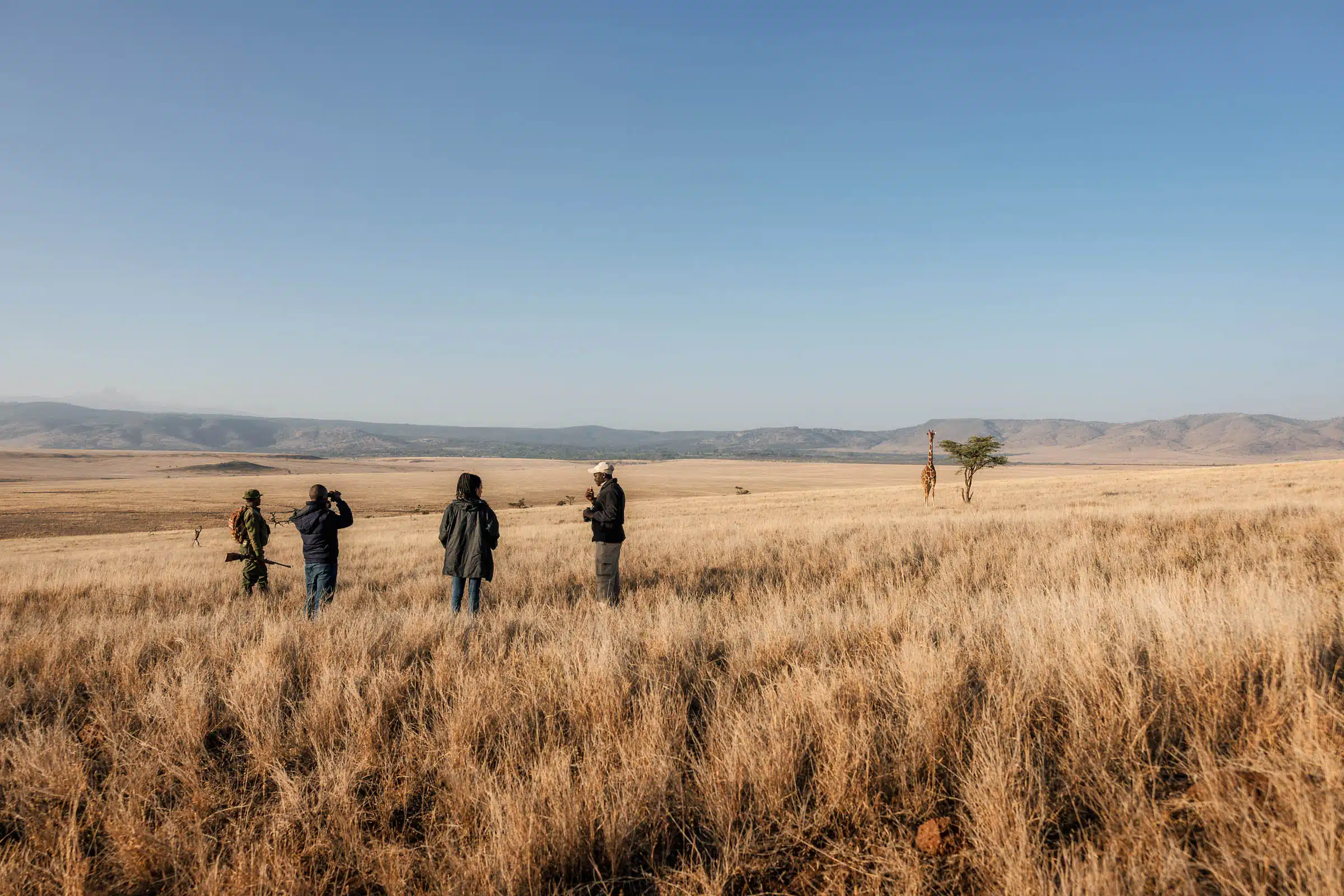

A walking safari in the Lewa Wildlife Conservancy puts you on the ground with black and white rhino, elephant, lion, and wild dog in a private conservancy holding 14 percent of Kenya’s entire rhino population, led by an armed ranger and Maasai tracker whose knowledge of the animals is built across years of daily contact.
A walking safari in the Lewa Wildlife Conservancy begins before the heat builds, with an armed ranger and Maasai tracker leading the group out from camp into terrain that holds more rhino per square kilometer than anywhere else in Kenya.
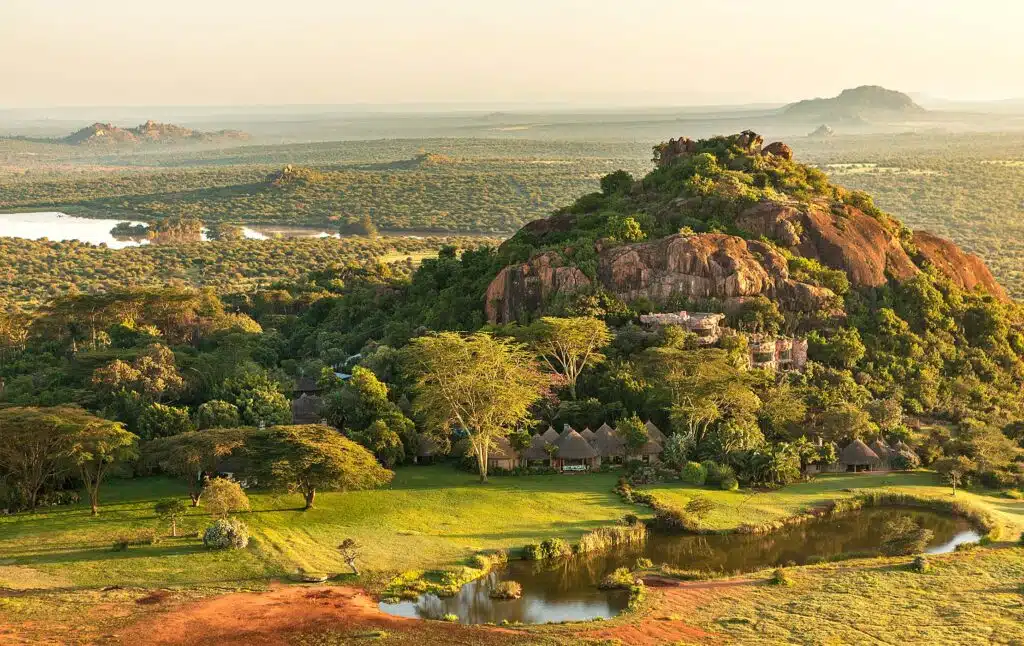
The conservancy covers 62,000 acres at the base of Mount Kenya, and the walk covers ground that no vehicle can reach in the same way, following tracks, reading the soil, and building a picture of the landscape from the ground up rather than from a seat.
Lewa holds 14 percent of Kenya’s entire rhino population, both black and white, along with the full complement of the Big Five, the Northern Specialty Species including the Grevy’s zebra and reticulated giraffe, wild dog, cheetah, and over 450 bird species.
The conservancy is fenced, which concentrates the wildlife and makes foot access to a range of species more consistent than in the open ecosystems of the Mara or Amboseli.

About Do Not Disturb
Do Not Disturb is a luxury travel company specializing in carefully designed journeys and considered experiences. Each itinerary we build for our clients is informed by real destination knowledge, offering insight into places, cultures, and moments that shape how a trip comes together.
If this destination has sparked ideas, the itinerary can be developed into a private journey tailored to your interests and travel style, with hand-picked stays, thoughtful routing, and experiences curated around what matters most to you.
Cultural and Historical Context
The Lewa Wildlife Conservancy began as a cattle ranch founded by the Craig family in the 1920s. By the early 1980s, Kenya’s black rhino population had been reduced from 20,000 to fewer than 300 in twenty years through poaching for the horn trade.
In 1983, the Craig family converted five thousand acres of the ranch into the Ngare Sergoi Rhino Sanctuary, starting with fifteen black rhinos. By 1995 the entire 62,000-acre ranch had converted to conservation and the Lewa Wildlife Conservancy was formally established.
The conservancy now holds more than 250 rhinos and has translocated dozens more to Borana, Sera, and other conservancies across Kenya. Its merger with the adjacent Borana Conservancy has created a 93,000-acre rangeland that functions as a single ecosystem.
The model Lewa pioneered, channeling tourism revenue into community education, healthcare, and agricultural programs, has become a reference point for conservation projects across East Africa.

Why Private or Small-Group Access Matters
A walking safari in Lewa operates with a maximum of four to six people on foot. With a private walk, the tracker follows what the ground is telling them rather than a predetermined route. If a set of rhino tracks leads toward a waterhole two kilometers off the planned path, a private group follows them.
The Maasai tracker has spent years working within this specific landscape, building an understanding of individual animals through daily contact. A rhino is identifiable by the shape of its tracks and the pattern of its movement.
The territory of the lion pride and the location of the wild dog pack’s den are things that accumulate across years of working in the same place, and none of it is available to a group large enough to generate noise that changes how the animals behave

What You See
Lewa holds both black and white rhino in numbers that make sightings on foot a realistic part of the walk. The tracker locates them by reading tracks in the soil and adjusts the route accordingly, approaching slowly and staying downwind until the group is close enough to observe without disturbing the animal.
Black rhino tend to move through the woodland and forest edges, while white rhino graze in the open grassland and are often encountered in small groups. The ranger reads the animal’s posture throughout, determining how long the group can hold position.
The conservancy’s terrain moves from open grassland to acacia woodland to the Ngare Ndare Forest on the northern boundary, where the temperature drops and the birdcall shifts as the canopy closes.
Elephant move through in family groups, and wild dog are followed by the tracker rather than anticipated, with the morning walk adjusted around where the pack was last located.

How Do Not Disturb Makes This Possible
Do Not Disturb works with a small number of lodges and rangers in the Lewa Conservancy whose knowledge of the terrain and the individual animals is consistent with what a private walking safari requires.
The timing of the walk is planned around the season and the specific behavior of the animals at the time of the visit. The dry season from June through October produces the most consistent sightings as wildlife concentrates around permanent water. The pre-walk briefing covers the terrain, the safety protocols, and the animals likely to be encountered, so that the walk itself can focus entirely on what is in front of the group rather than on logistics.
Ready to plan your walking safari in the Lewa Wildlife Conservancy and experience Kenya’s most significant conservation story on foot? Speak with Do Not Disturb to begin your journey.
Plan your own version of this journey
Speak to Do Not Disturb’s luxury travel experts and turn this moment into something personal.
Related destinations
Suggested articles
Where to Go On Honeymoon? A Guide to Help You Choose

Why Kenya Is Perfect for a Luxury Honeymoon
Wilderness to Waves: Luxury Honeymoons in Kenya

Kenya vs. South Africa for a First Safari

Serengeti vs. Maasai Mara: Which Luxury Safari Is Right for You?

Best Winter Sun Honeymoon Destinations in Europe
Portugal vs Spain for Your Honeymoon – Which Should You Choose?

One Island or Two? Splitting Your Maldives Honeymoon Between Resorts

Best Honeymoon Destinations for Autumn

Italy vs Greece for Your Honeymoon – Which is Better?

48 Hours in Lima: Where to Eat, Stay and Explore

A Cultural Honeymoon in Peru: Machu Picchu, Cusco, the Sacred Valley and the Amazon

Peru or Mexico: Which Ancient Civilization Should You Visit First?