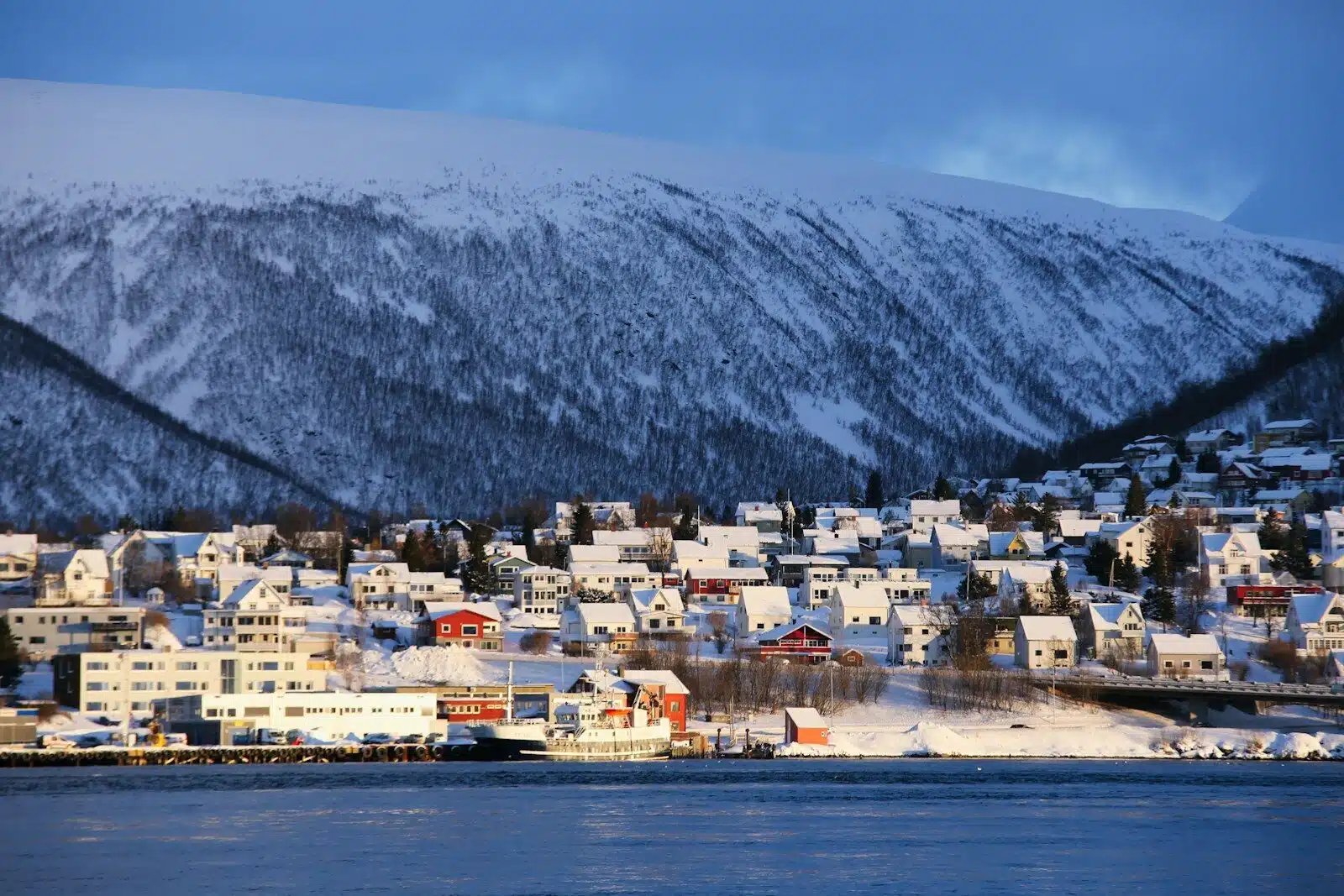

Positioned at 69 degrees north, Tromsø is the largest urban center in the Norwegian Arctic and the most credible base from which to experience the region’s wilderness, culture, and extraordinary light.
Understanding Tromsø: A City Built for the Extreme
Tromsø sits on a small island in the Tromsfjord, 217 miles north of the Arctic Circle, connected to the mainland by bridge. It has been a significant Arctic hub since the 19th century, when it served as the departure point for polar expeditions led by Nansen, Amundsen, and others whose names are still on the streets.
Around 75,000 people live here permanently, which makes it a functioning city rather than an outpost, with restaurants, museums, a cathedral, and a university whose Arctic research department is among the most respected in the world.
That permanent infrastructure is what separates Tromsø from other northern lights destinations. The guides here are not seasonal workers running standard tours. Many are glaciologists, marine biologists, and Sami cultural practitioners whose knowledge of the Arctic environment goes considerably deeper than knowing where to park a minibus on a clear night. The difference shows in the experience.

About Do Not Disturb
Do Not Disturb is a luxury travel company specializing in carefully designed journeys and considered experiences. Each itinerary we build for our clients is informed by real destination knowledge, offering insight into places, cultures, and moments that shape how a trip comes together.
If this destination has sparked ideas, the itinerary can be developed into a private journey tailored to your interests and travel style, with hand-picked stays, thoughtful routing, and experiences curated around what matters most to you.
Where to Stay
Tromsø’s accommodation offer is anchored by a small number of properties that combine serious service with considered design. Clarion Hotel The Edge sits on the waterfront with floor-to-ceiling views across the Tromsfjord and direct access to the city’s main cultural and dining infrastructure. Scandic Ishavshotel occupies a central harbor position with consistent standards and the kind of established local knowledge that comes from decades of hosting Arctic travelers.
Beyond the main hotels, a small number of design-forward lodges outside the city offer a more immersive Arctic setting, trading proximity to Tromsø’s restaurants and nightlife for direct access to the wilderness. These work best as part of a split itinerary, a night or two in the city followed by nights further out, rather than as a standalone base.
Accommodation during peak aurora season, November through March, and again in summer for the midnight sun fills quickly. Securing the right property at the right time requires planning considerably further ahead than most European city breaks.

At the Table: Tromsø's Evolving Restaurant Scene
Tromsø’s restaurant scene has developed well beyond what its population of 75,000 might suggest. A generation of chefs has built serious menus around the Arctic larder: reindeer from inland Sami herders, king crab from the Barents Sea, and skrei, the migratory cod that arrives in northern Norwegian waters between January and April. These are not decorative ingredients. They are the basis of how the best kitchens here cook.
At the refined end, tasting menus offer structured progressions through Arctic produce, with sourcing and technique given equal weight. The standard is consistent enough that Tromsø now draws food-focused travelers who would previously have looked only to Oslo or Bergen.
The casual tier has kept pace. Several well-regarded restaurants operate outside the tasting menu format without sacrificing ingredient quality or kitchen discipline. The range means that dining in Tromsø can be calibrated to the pace of a given evening without compromising on what is on the plate.

The Northern Lights: Managing Expectations and Maximizing Access
The Northern Lights are visible in Tromsø from late September through late March, when darkness is sufficient to observe geomagnetic activity. Clear skies and a Kp index of at least 3 are the baseline requirements, but neither is guaranteed. The aurora is a natural phenomenon governed by solar activity, and no operator can promise a sighting. What competent guidance does provide is the ability to move efficiently, reading cloud cover patterns and repositioning away from coastal weather systems that frequently obscure the sky.
Private excursions differ from group tours in one practical respect: flexibility. A private arrangement allows real-time route changes based on forecast data, without the constraints of fixed itineraries or shared decision-making across a group.
The quality of the experience is closely tied to the knowledge and local relationships of whoever arranges it. Access to private land, remote fjord positions, and reliable meteorological interpretation are not uniformly available, and the difference between a productive night and a wasted one often comes down to exactly that.

Arctic Excursions: Into the Wilderness Beyond the City
The wilderness surrounding Tromsø is accessible through a range of structured expeditions, each with distinct logistical and cultural profiles. Dog sledding operations in the Lyngen Alps and Tamok Valley use Alaskan and Greenlandic huskies across routes that vary in duration and terrain. Snowmobile expeditions extend further into the plateau, covering distances impractical on foot or ski. Fjord cruises operate year-round, with winter departures oriented toward northern lights observation and wildlife, particularly sea eagles and harbor porpoises.
Reindeer encounters offered in partnership with Sámi communities represent a different category of experience. These are not wildlife excursions but cultural engagements, structured around the herding practices and land relationships of indigenous families operating under Sámi reindeer husbandry rights. The quality and authenticity of these encounters depends entirely on which community is involved and how the visit is facilitated.
Standards across operators vary considerably. The most credible providers hold certification from Ecotourism Norway and operate with defined guest-to-guide ratios, particularly on technical terrain.

Planning Your Visit: Seasons, Logistics, and What to Prioritize
Tromsø divides cleanly into two distinct travel seasons, each with a different purpose. Polar night runs from late November to mid-January, when the sun does not rise above the horizon and aurora activity is at its most reliable. Midnight sun operates from mid-May to late July, offering continuous daylight suited to hiking, fjord travel, and extended time outdoors. Neither season is superior; the choice depends entirely on what the traveler is there to see.
Direct flights operate from Oslo year-round, with a flight time of approximately two hours. Seasonal routes connect from select European hubs, though availability varies. Tromsø Airport sits close to the city center, making arrival straightforward.
A well-structured visit typically requires a minimum of five nights to balance time in the city with excursions further into Troms County or toward the Lyngen Alps. The surrounding region rewards depth over distance, and itineraries that account for weather contingency consistently produce better results than those built around fixed daily schedules.
Plan your own version of this journey
Speak to Do Not Disturb’s luxury travel experts and turn this moment into something personal.
Related destinations
Suggested articles
Beyond the Maldives: Seven Islands for a Different Kind of Honeymoon
The Ultimate Norway Honeymoon Guide

Svalbard: Europe’s Last Great Wilderness

One Island or Two? Splitting Your Maldives Honeymoon Between Resorts

Best Honeymoon Destinations for Autumn

Italy vs Greece for Your Honeymoon – Which is Better?
48 Hours in Lima: Where to Eat, Stay and Explore

A Cultural Honeymoon in Peru: Machu Picchu, Cusco, the Sacred Valley and the Amazon

Peru or Mexico: Which Ancient Civilization Should You Visit First?
The Best Time to Visit Machu Picchu for Fewer Crowds
Why So Many Travelers Fall for Kanazawa
Kyoto or Kanazawa – Which Is Better for Traditional Japan?
What Is a Kissaten? Inside Japan’s Historic Coffee Shop Culture